Adaptability is a system’s capacity to change how it behaves or is organized in response to experience. In AI, it marks a move beyond fixed logic toward learning, through approaches that have shifted from symbolic programs to probabilistic models and neural networks. section 1.4
Learning can change a system’s internal organization. In neural networks, experience alters connection strengths, biasing which pathways activate. This resembles one aspect of biological plasticity, not its full machinery, and limits what artificial learning can capture. section 5.2.3
For pretrained language models, adaptation can update all parameters, modify only a subset, or add trainable components while keeping other parts frozen. These methods specialize learned transformations rather than retraining from scratch; shifting too far toward new data or objectives can cause catastrophic forgetting. section 4.3.1
Figure 4.13 Pretraining and model adaptation. Models are first trained on broad data, then specialized through full or partial parameter updates.
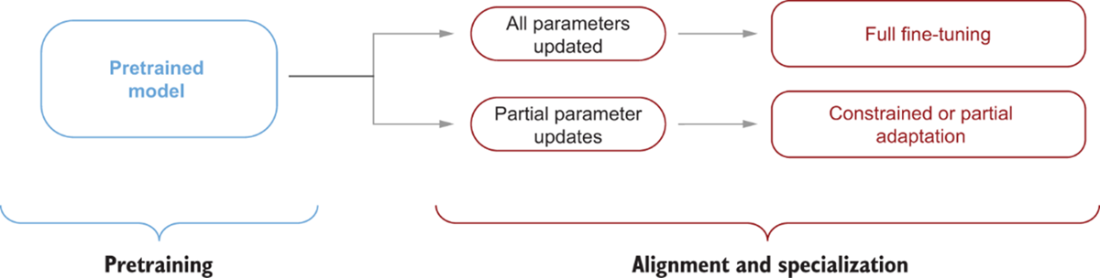
The figure contrasts broad pretraining with specialization through full or partial parameter updates. section 4.3.1
Flexible adaptation across contexts contributes to AI competence, but does not establish human-like cognition. Performance remains uneven and depends heavily on training data, prompts, tools, and surrounding systems. section 9.5.6






