liveBook · Manning

Adapter

As explained in Effective Platform Engineering

An adapter pattern is a design pattern that standardizes interaction between incompatible interfaces or data representations by translating one into another.

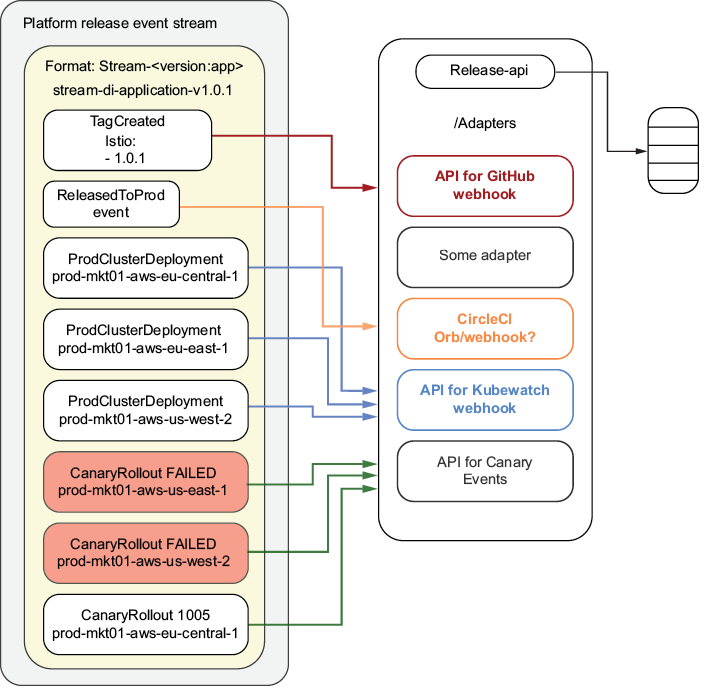
An adapter translates events from incompatible systems and formats into a standardized event model. Separating event publishing from consumption lets a release API collect diverse events while consumers subscribe through one consistent interface. section 9.3.2

A platform can adapt TagCreated events from GitHub, ReleasedToProd events from CircleCI, deployment events from Kubernetes, and canary events from ArgoCD or Flagger. Standardized events then support consumer plugins for JIRA, ServiceNow, source control, CI/CD, and configuration management databases. section 9.3.2

Deployment events in observability

An observability consumer pushes deployment events into a metrics platform. When Team A’s HTTP errors rise after Team B releases version 1.2, correlated deployment data makes the likely upstream change visible, speeding diagnosis and reducing escalations. section 9.3.5

Figure 9.8 To consume the events in our release-api, we’ll need a pattern from the many systems that produce them.
A diagram of a cell phone

AI-generated content may be incorrect.

Use the event-source diagram to trace why each producing system needs an adapter before events can enter the release API. section 9.3.2


How Effective Platform Engineering covers it

How deep it goes
Explains adapter boundaries, event normalization, publisher-consumer separation, and observability correlation without detailing adapter implementation code.
Examples
Uses GitHub, CircleCI, Kubernetes, ArgoCD, Flagger, OpenTelemetry, metrics platforms, and deployment-event correlation as concrete examples.
What you can do after
Diagnose deployment-related incidents by correlating normalized release events with service health metrics.
How it connects
Connects event-driven architecture, platform APIs, observability, consumer plugins, deployment systems, and configuration management databases.

Also explained in

Compare how 9 books explain adapter →

Related concepts

This explainer was generated by Manning's knowledge graph from the text of Effective Platform Engineering. The section links point to the parts of the book it draws on.






