The Adapter Design Pattern integrates components whose interfaces do not match, especially when external or legacy code cannot be changed. It converts an adaptee’s interface into the target interface expected by clients. section 10.0 section 10.1
From duplicated conversions to adapters
An attendance report needs venue and fan data through AttendanceData, but FootballInfo returns a pair and VolleyballStats returns a struct. A flawed report performs both conversions itself, coupling reporting to every external representation. FootballData and VolleyballData instead implement AttendanceData, wrap their respective objects, and provide get_venue() and get_attendance(). AttendanceReport then accepts one AttendanceData object and no longer performs conversions. section 10.1.3
Choose the adapter form according to the integration needs:
- Use an object adapter when composition is suitable, when an adapter may be shared, or when adaptee subclasses should also be wrapped. section 10.1.5
- Use a class adapter when multiple inheritance is acceptable, the client should hide the adaptee type, or adaptee functions may need overriding. section 10.1.5
- Keep conversion responsibilities inside adapters so clients depend on the target interface rather than external data representations. section 10.1.3
Figure 10.3 The generic model of the Adapter Design Pattern. Compare with figure 10.2. The Adapter class implements the Target interface. It adapts an Adaptee class by wrapping it so that the latter can work with the Target interface.
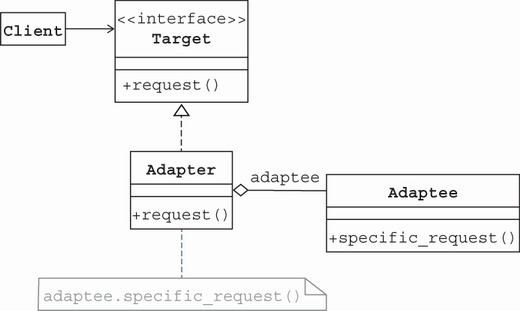
The generic model maps the Target interface to the Adapter, the Adapter to the wrapped Adaptee, and client requests to converted specific requests. section 10.1.4








