AGORA is a proprietary programming language for representing and executing the smart agent paradigm. It lets programmers describe agent activity through abstract keywords rather than repeatedly coding basic instructions. section 4.1.2
AGORA provides language-level support for smart-agent reasoning:
- Includes internal functions, structures, storage allocation, garbage collection, and memory management. section 4.1.2
- Uses more than 40 keywords, including goal, neighbors, behavior, environment, output, stabilize, and unstabilize. section 4.1.2
- Associates keywords with agent activity; stabilize marks an acceptable state, while unstabilize identifies a state that should never be allowed. section 4.1.2
River-crossing puzzle
A farmer must transport a wolf, goat, and cabbage across a river using a raft that carries only the farmer and one item. The goat cannot remain with the wolf, and the cabbage cannot remain with the goat. AGORA provides a smart-agent language context for expressing the states and constraints involved. section 4.1.2
Figure 4.1 MINDsuite AI platform
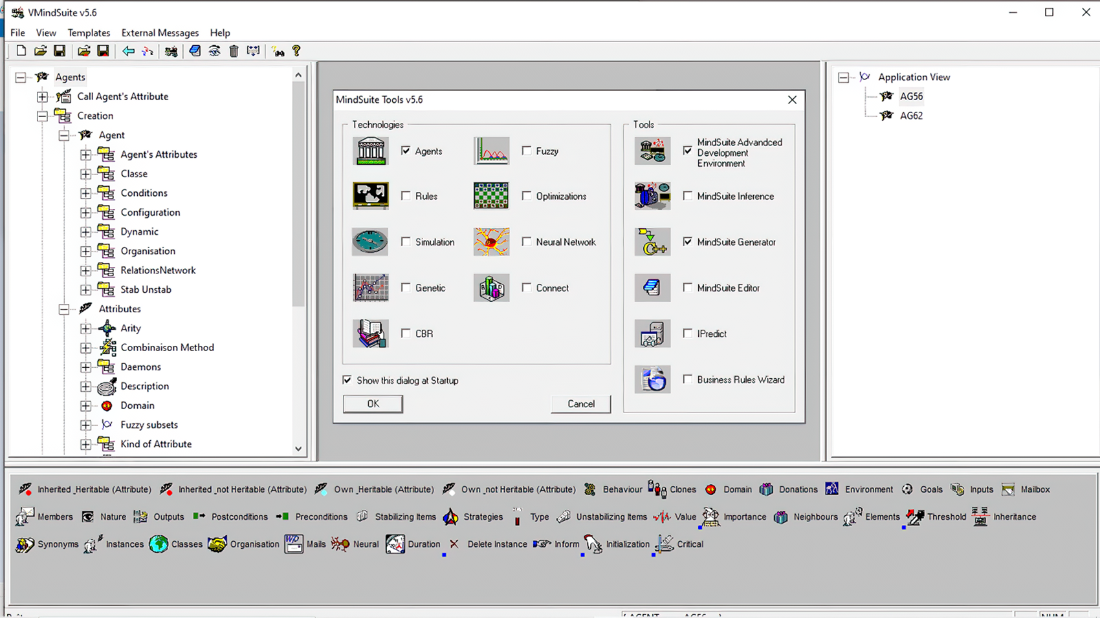
Shows MINDsuite, the platform associated with AGORA and integrated smart-agent technologies. section 4.1.2
