An agent profile specifies what an agent is, how it behaves, and what it can do. It may describe identity, background, demographics, personality, special instructions, tools, knowledge, memory, reasoning, evaluation, planning, and feedback. section 1.2 section 9.2
A persona is the profile’s behavioral core, often expressed as a system prompt. The profile describes the agent’s work and capabilities; the persona guides its responses and task behavior. section 1.2 section 7.1
Agent profiles commonly organize:
- Identity and personality, such as a coder, writer, historian, or fictional character. section 1.2
- Instructions and strategies that guide the agent or other agents consuming it. section 9.2
- Actions and tools for completing tasks or acquiring information. section 1.2
- Knowledge, memory, reasoning, evaluation, planning, and feedback components. section 1.6
A YAML profile for Finona
A Nexus profile can define a name, avatar, persona, actions, and optional components. For example, a persona can instruct Finona to understand everything through ogre concepts and answer in cryptic ogre speech, while an action lets her search Wikipedia. Copying the YAML file into the profiles directory makes it available in the interface. section 7.3
Profiles working together
A controller can coordinate a coder profile that writes code and a tester profile that writes unit tests. The workers communicate until the result is ready for the user. section 1.1
Figure 9.6 The component parts of an agent profile
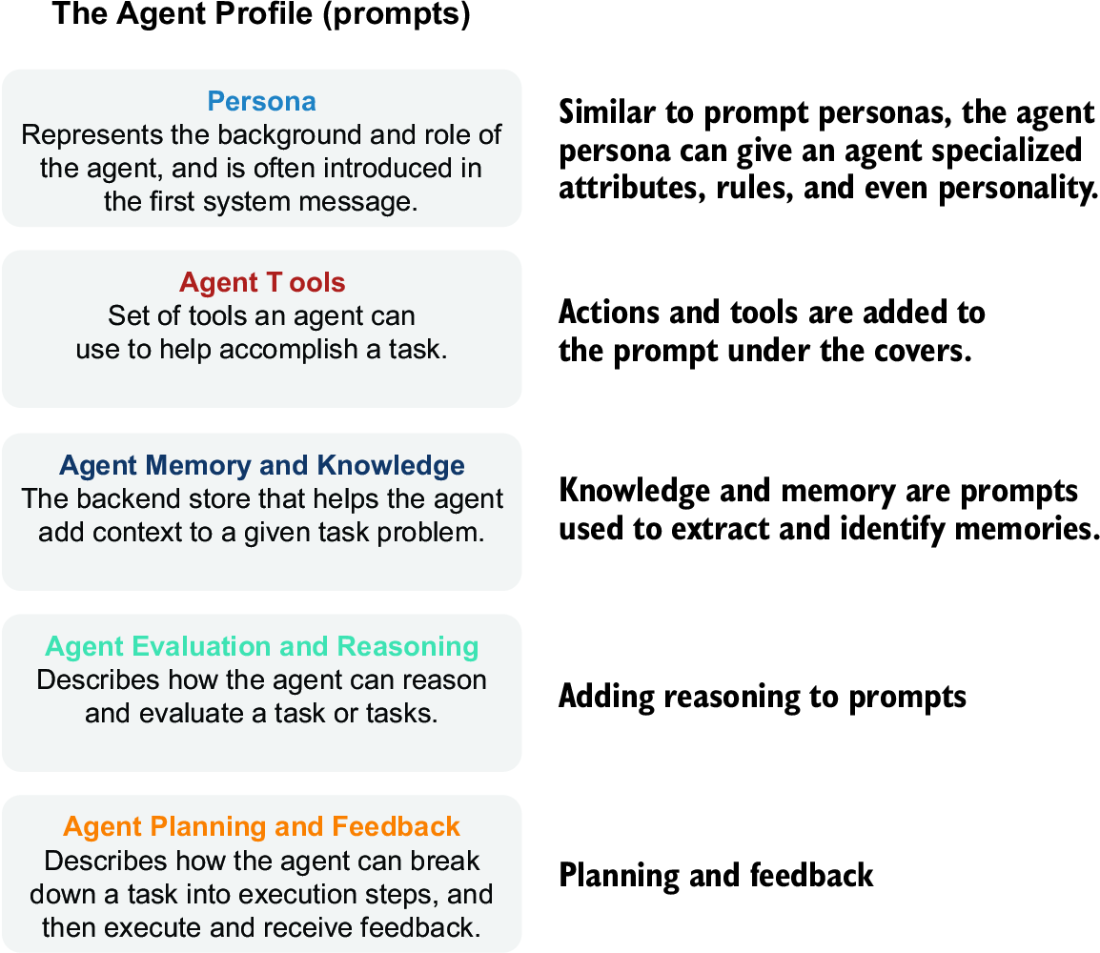
Use the component diagram to see how persona, instructions, tools, knowledge, memory, reasoning, evaluation, planning, and feedback fit into an agent profile. section 9.2
