Agentic RAG gives an AI agent control over retrieval: it can decide when a question needs multiple searches, then synthesize the results. It can also combine stored documents with actions or services that provide current information. section 3.7.8 section 6.3
Two kinds of information need
To compare electronics and clothing return policies alongside customer reviews, the agent queries the relevant policy and review sources, then combines the findings. For trip planning, it can pair document retrieval with a weather service to address current conditions that stored knowledge cannot provide. section 3.7.8 section 6.3
A practical travel assistant can combine a vector store with tools such as a weather API. One implementation uses a ReAct-based TypeScript chat interface that displays selected tools and reasoning steps; a Python equivalent provides the same agent behavior. section 6.3.1
Figure 6.6 An Agentic RAG system consisting of a weather tool (API) and vector store (RAG)
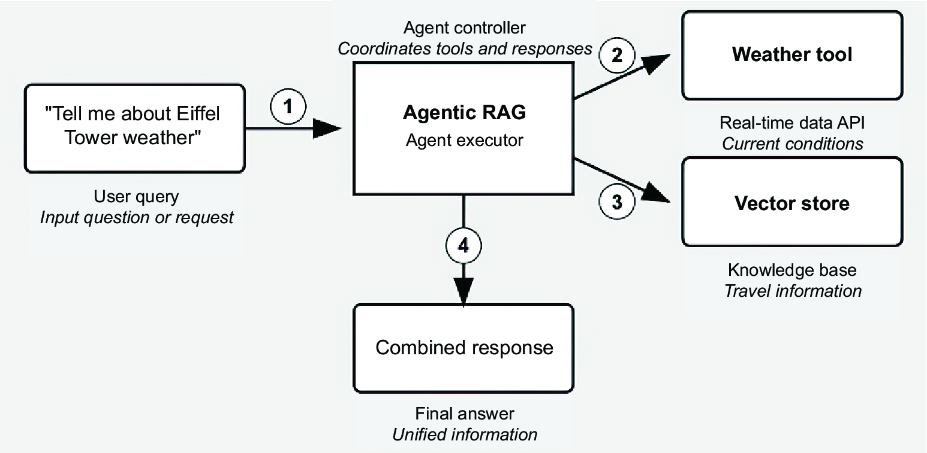
Illustrates an agentic RAG setup combining a weather API tool with a vector store. section 6.3.1



