LangChain
LangChain is an open-source software framework for building applications that compose language models with prompts, data sources, tools, and other components.
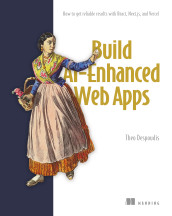
Build AI-Enhanced Web Apps
LangChain is a software framework, including its JavaScript implementation, for composing applications that use language models, tools, retrieval, and multi-step chains.
- How it is used
- Builds context-aware web applications through composable chains, retrieval, memory, and agents.
- How deep it goes
- Walks through JavaScript integrations and application workflows while focusing on selected features rather than the entire ecosystem.
- Examples
- Uses a streaming weather chain, document summarization, a RAG application, and an MCP-connected joke agent.
- What you can do after
- Apply LangChain.js to compose workflows, integrate retrieval and streaming, and test components with fake models and retrievers.
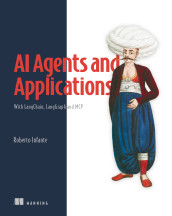
AI Agents and Applications
LangChain is an open-source framework for building applications that combine language models with data sources, tools, and multi-step workflows.
- How it is used
- Uses reusable components to assemble language-model applications, including retrieval, prompting, and multi-step workflows.
- How deep it goes
- Explains the object model and retrieval architecture, then builds prompts, summarization chains, and Q&A applications.
- Examples
- Uses a phishing reminder, few-shot number classification, and a web research summarization engine.
- What you can do after
- Apply it via LangChain to build summarization and retrieval-based Q&A applications.

Natural Language Processing in Action, Second Edition
LangChain is a software framework for developing applications that combine language models with tools, data sources, and orchestration logic.
- How it is used
- Integrates language models into chatbot NLP pipelines while abstracting model-specific APIs.
- How deep it goes
- Walks through model configuration, prompt templates, chains, and conversation memory, while illustrating unreliable generated responses.
- Examples
- Builds a math tutor that requests parental permission and quizzes students on number sequences.
- What you can do after
- Apply it via LangChain to assemble a model-backed conversational chatbot with prompts and buffered history.
Read how Natural Language Processing in Action, Second Edition explains LangChain →
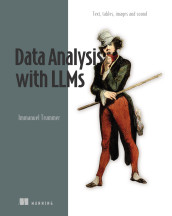
Data Analysis with LLMs
LangChain is an open-source software framework for developing applications that integrate language models with prompts, data, and external actions.
- How it is used
- Connects language models, prompts, processing steps, and tools for data-analysis applications that need more than one model call.
- How deep it goes
- Works through a classification chain and an agent setup, but defers detailed coverage of the framework.
- Examples
- Uses CSV review sentiment classification and an agent that combines an SQLite sales database with web search.
- What you can do after
- Apply it via LangChain to classify reviews or configure an agent with SQL and web-search tools.

MongoDB 8.0 in Action, Third Edition
LangChain is a software framework for building applications that compose large language models with prompts, tools, memory, and retrieval components.
- How it is used
- Coordinates LLMs, embeddings, external data, and vector search for a RAG chatbot.
- How deep it goes
- Names framework packages and walks through template setup and PDF ingestion, without detailing LangChain internals.
- Examples
- Uses a `rag-mongo` application template and a MongoDB documentation PDF to populate a vector-search collection.
- What you can do after
- Apply it via the LangChain CLI and `rag-mongo` template to ingest PDF embeddings and expose a chatbot chain.
Read how MongoDB 8.0 in Action, Third Edition explains LangChain →

Generative AI in Action
LangChain is a software framework that provides modular components for building applications around large language models and related natural-language services.
- How it is used
- Supports assembling generative AI application workflows, including document question answering.
- How deep it goes
- Demonstrates document splitting, embedding, and index creation in a partial question-answering listing.
- Examples
- Uses a PDF question-answering application with overlapping text chunks and a FAISS index.
- What you can do after
- Apply it via LangChain to assemble the indexing portion of a PDF question-answering workflow.
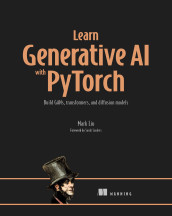
Learn Generative AI with PyTorch
A Python library for building applications with large language models through tools, abstractions, and component chaining.
- How it is used
- Builds LLM applications that automate workflows and route queries across models, APIs, and task-specific tools.
- How deep it goes
- Explains abstractions, tool selection, and incremental agent construction, then demonstrates code and image tools without detailing library internals.
- Examples
- Demonstrates factual lookup, scientific computation, sine-and-cosine code generation, text summarization, sentiment classification, and image generation.
- What you can do after
- Build it from scratch by combining an LLM, prompt templates, APIs, and custom tools into a zero-shot agent.
Read how Learn Generative AI with PyTorch explains LangChain →

The Art of AI Product Development
LangChain is a software framework for developing applications that compose language models with prompts, retrieved context, memory, tools, and other components.
- How it is used
- Organizes language-model prompts, context, memory, tools, and workflows into application-ready components.
- How deep it goes
- Explains modular prompt development and framework capabilities, while stopping short of detailed implementation code or internals.
- Examples
- Uses Alex's release workflow, reusable prompts, version control, rollback, and agent memory as concrete examples.
- What you can do after
- Apply it via LangChain to structure prompt iteration and connect language models with context, memory, tools, and workflows.
Read how The Art of AI Product Development explains LangChain →

LLMs in Production
LangChain is a software framework for building applications that combine language models with prompts, tools, data sources, and workflow logic.
- How it is used
- Builds language-model pipelines that combine prompts, models, parsers, retrieval, tools, APIs, and workflow logic.
- How deep it goes
- Demonstrates basic chain composition and broader agents, while exposing practical failures without detailing framework internals.
- Examples
- Uses prompt-model-parser chains, web and YouTube search, Python execution, CSV analysis, conversation memory, and local Mistral agents.
- What you can do after
- Builds chains and tool-using agents, hosts them through LangServe, and traces invocations with LangSmith.
Starting Data Analytics with Generative AI and Python
LangChain is a software framework for developing applications that compose language models with prompts, tools, data sources, and conversation state.
- How it is used
- Simplifies API access and local-model integration for generative-AI data-analysis workflows.
- How deep it goes
- Demonstrates installation, model invocation, and memory limitations, but defers detailed configuration to current library instructions.
- Examples
- Uses Python API integration, a local quantized Llama model, installation commands, and a LlamaCpp prompt invocation.
- What you can do after
- Apply it via Python to connect language models, send prompts, capture responses, and add conversation memory.
Read how Starting Data Analytics with Generative AI and Python explains LangChain →
Fight Fraud with Machine Learning
LangChain is a software library for building applications that integrate language models with prompts, tools, data sources, and application workflows.
- How it is used
- Builds Python applications that connect LLM prompts to hosted or local models for phishing detection and other text tasks.
- How deep it goes
- Explains setup, prompt templating, model loading, chain execution, batch generation, and local inference, but not LangChain internals.
- Examples
- Uses phishing-email yes/no prompts, FLAN-T5 classifications, batched questions, and a local Mistral model.
- What you can do after
- Build a phishing detector by defining prompts, loading an LLM, running chains, and selecting hosted or local inference.
Read how Fight Fraud with Machine Learning explains LangChain →
Software Testing with Generative AI
LangChain is a software library and toolset for developing applications that integrate with language models.
- How it is used
- Builds retrieval-augmented testing assistants that supply relevant user stories to language-model prompts.
- How deep it goes
- Demonstrates document loading, query input, cosine-distance retrieval, prompt construction, and model invocation, while noting retrieval limitations.
- Examples
- Uses a Java command-line assistant that retrieves booking user stories and recommends testing risks.
- What you can do after
- Build it from scratch as a Java RAG workflow that loads documents, retrieves context, and sends prompts to OpenAI.
Read how Software Testing with Generative AI explains LangChain →
Machine Learning Platform Engineering
LangChain is a software framework for building applications that compose language models with prompts, tools, retrieval, and other processing components.
- How it is used
- Builds LLM applications by composing retrieval, prompts, models, tools, and processing components into maintainable pipelines.
- How deep it goes
- Explains component interfaces and RAG composition, then stops short of the branching and iterative workflows assigned to LangGraph.
- Examples
- Demonstrates manual RAG, RetrievalQA, FAISS, OpenAI embeddings, Google embeddings, and Langfuse callbacks.
- What you can do after
- Build it from scratch as a composable RAG pipeline with retrievers, chains, validation, source documents, and operational tracing.
Read how Machine Learning Platform Engineering explains LangChain →
Effective Conversational AI
LangChain is a software library for developing applications that compose language models with prompts, data sources, retrieval, and other processing components.
- How it is used
- Simplifies retrieval-augmented generation ingestion by connecting document loading, transformation, and retrieval.
- How deep it goes
- Defines ingestion components and formats, then introduces chunking and search choices without detailing a complete application.
- Examples
- Uses text files, CSV files, directories, PDFs, HTML, JSON, Markdown, web pages, transcripts, and corporate documents.
- What you can do after
- Operate and configure an ingestion pipeline that loads documents and retrieves relevant chunks for language-model responses.
Data Storytelling with Altair and AI
LangChain is a software framework for building applications that connect language models with prompts, external data sources, and other components.
- How it is used
- Connects language models to prompts, indexes, and external data for context-aware applications.
- How deep it goes
- Explains chains and components, then demonstrates loading, chunking, embedding, retrieval, prompting, and querying.
- Examples
- Uses a smartphone HTML page, Chroma collection, OpenAI embeddings, a constrained prompt, and a RetrievalQA query.
- What you can do after
- Build a retrieval-augmented application that answers product questions from indexed HTML context.
Read how Data Storytelling with Altair and AI explains LangChain →
The Complete Obsolete Guide to Generative AI
LangChain is a software framework for building applications that coordinate large language models with tools, data sources, and multistep operations.
- How it is used
- Coordinates LLMs with search, math, and document-retrieval tools for multilayered research and analysis.
- How deep it goes
- Demonstrates runnable agent and retrieval pipelines but does not explain their underlying model or vector-store internals.
- Examples
- Uses web research about David Clinton’s publications and compares Alphabet, Cisco, and IBM financial filings.
- What you can do after
- Apply it via LangChain to build Python agents that search the web or compare multiple PDF documents.
Read how The Complete Obsolete Guide to Generative AI explains LangChain →
Build Applications with Local AI Models on a Mac
LangChain is a software framework for building applications with language models by connecting them to data sources and composable components.
- How it is used
- Extends a working chatbot with reusable components for retrieval, memory, tools, and multistep workflows.
- How deep it goes
- Introduces component roles and a basic model invocation, while deferring comprehensive LangChain instruction.
- Examples
- Uses a local Ollama model to answer a capital-city question and suggests branching chains and custom tools as extensions.
- What you can do after
- Apply it via LangChain to invoke a local model and build chains, agents, and tool-using applications.
Read how Build Applications with Local AI Models on a Mac explains LangChain →

Just Use Postgres!
LangChain is a software framework for building applications that compose language models with prompts, tools, data sources, and processing steps.
- How it is used
- Connects Python applications, prompts, retrieved Postgres context, and language models for generative-AI question answering.
- How deep it goes
- Demonstrates prompt construction, model invocation, RAG flow, and stateless-history handling without deeper framework internals.
- Examples
- Uses TinyLlama, an OllamaLLM interface, a movie prompt, and retrieved Pirates of the Caribbean records.
- What you can do after
- Apply it via Python to build a RAG question-answering function backed by Postgres and an Ollama-served language model.
Investing for Programmers
LangChain is a software framework for building applications that compose large language models with prompts, tools, data sources, and workflow logic.
- How it is used
- Builds Python workflows that combine LLM prompts with provider integrations, external data, and agent tools.
- How deep it goes
- Explains provider abstraction, invoke(), one-shot prompts, and tool-using agents through executable listings.
- Examples
- Demonstrates a Google SWOT prompt and a Yahoo Finance News agent answering what happened with Microsoft stock.
- What you can do after
- Apply it via Python to invoke multiple LLM providers and build agents that retrieve financial information through tools.
Building Reliable AI Systems
LangChain is an open-source software framework for building applications that coordinate language models with prompts, data sources, tools, and retrieval workflows.
- How it is used
- Connects language models, prompts, data, and tools to prototype RAG applications with less integration work.
- How deep it goes
- Explains component roles and helper use for RAG, while deferring detailed retrieval-chain and question-answering features.
- Examples
- Uses a simple RAG system, document loading and text splitting, and a chatbot retrieving product information.
- What you can do after
- Apply LangChain to connect components and prototype a RAG workflow or chatbot.
Retrieval Augmented Generation, The Foundational Ideas
LangChain is a software framework for building applications that coordinate language models with prompts, data sources, tools, and workflows.
- How it is used
- Accelerates RAG prototyping and supports complex chains and agentic workflows.
- How deep it goes
- Compares abstraction level, strengths, and production tradeoffs but does not explain implementation internals.
- Examples
- Uses rapid RAG prototyping, complex chains, production debugging, and framework-selection comparisons as examples.
- What you can do after
- Evaluate LangChain against alternative frameworks according to pipeline complexity, control requirements, and debugging needs.
Read how Retrieval Augmented Generation, The Foundational Ideas explains LangChain →
Also covered in
- Grokking AI Applications
- Hugging Face in Action
- Knowledge Graphs and LLMs in Action
- Data Pipelines with Apache Airflow, Second Edition
- Build Python Web Apps with Streamlit
- Context EngineeringIn early access (MEAP)
- Building LLM Applications with DSPy
- AI Agents in Action
What to know first
- language modelA language model is a computational model that represents patterns in linguistic sequences to assign probabilities, predict, generate, or evaluate language.
- retrieval-augmented generationRetrieval-augmented generation is a technique that retrieves relevant information from external sources and supplies it as context to a generative model when producing an output.
- PythonPython is a high-level, general-purpose, dynamically typed programming language with readable syntax and support for multiple programming paradigms.
- toolA software tool is a capability or utility that enables a person or system to perform a defined task or operation.
Related concepts
- language modeluses · A language model is a computational model that represents patterns in linguistic sequences to assign probabilities, predict, generate, or evaluate language.
- retrieval-augmented generationuses · Retrieval-augmented generation is a technique that retrieves relevant information from external sources and supplies it as context to a generative model when producing an output.
- contractuses · A contract is an agreed specification of the conditions, expectations, rights, or obligations that govern behavior or interactions between parties or software components.
- prompt templateuses · A prompt template is a reusable structure for organizing fixed instructions and content with variable inputs to form prompts for a language model.
- LangGraphused by · LangGraph is a framework for building stateful, graph-structured workflows and applications, including those involving language models and agents.
Questions about LangChain
What is LangChain?
LangChain is an open-source software framework for building applications that compose language models with prompts, data sources, tools, and other components.
Which Manning books explain LangChain?
Build AI-Enhanced Web Apps, AI Agents and Applications, Natural Language Processing in Action, Second Edition, Data Analysis with LLMs, MongoDB 8.0 in Action, Third Edition, Generative AI in Action, Learn Generative AI with PyTorch, The Art of AI Product Development and 13 more.
What should I know before learning LangChain?
Manning books that teach LangChain usually introduce language model, retrieval-augmented generation, Python and tool first.
These guides are generated from the text of Manning books by Manning's knowledge graph and link to the sections they draw on. The full books are available on liveBook and at manning.com.