LangChain is a Python library for building LLM applications around prompts, model access, and execution workflows. In phishing detection, it connects a prompt template to a HuggingFace-hosted model through an LLM chain. section 5.3 section 5.3.1
A practical LangChain workflow includes:
- Create a Python environment, install dependencies, and configure a HuggingFace API token when using hosted models. section 5.3.1
- Define a PromptTemplate with an input variable and an explicit Answer instruction so the model returns a classification response. section 5.3.1
- Load a model with HuggingFaceHub, combine it with the prompt in LLMChain, and execute the chain. section 5.3.1
- Process multiple question dictionaries with the chain's generate method and inspect the returned generations. section 5.3.2
- Replace hosted inference with a locally downloaded GPT4All model through LlamaCpp when API-free, commercially usable execution is preferred. section 5.4.1
Classifying a suspicious email
A prompt asks, "Is this a phishing email? (yes/no)" and includes an account-lockout message directing the recipient to reset a password through a link. The chain runs the prompt against Google's FLAN-T5 model and returns "Yes". section 5.3.1
Figure 5.19 Steps to build and run phishing detection on a Python notebook using HuggingFace and LangChain
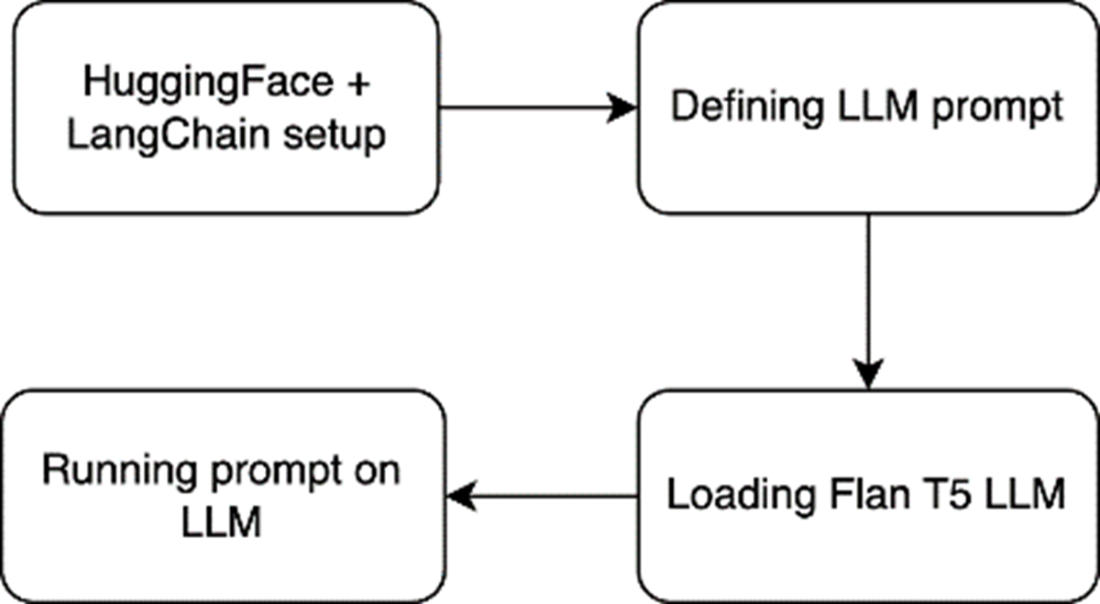
Use the workflow diagram to trace environment setup, prompt construction, model initialization, chain execution, and phishing-detection output. section 5.3.1




















