LangChain is an open-source framework for assembling applications that use language models, data sources, and tools. A question-answering chatbot, for example, must load documents, find relevant passages, build a prompt, call a model, and return an answer. LangChain supplies reusable components for those steps instead of requiring separate integration code for each one. section 1.2 section 7.1
A typical document-backed workflow has two stages:
- Index content: loaders turn files, websites, or database content into Document objects; splitters create chunks; embedding models and vector stores prepare them for similarity search. section 1.2.1 section 1.2.2
- Answer a question: a retriever selects relevant chunks, a prompt combines them with the question, and a language model generates a response. Retrieving selected passages helps respect context limits instead of pasting whole documents into every prompt. section 1.2 section 1.4.2
Figure 1.6 LangChain architecture. The document loader imports data, which the text splitter divides into chunks. These are vectorized by an embedding model, stored in a vector store, and retrieved through a retriever for the LLM. The LLM cache checks for prior requests to return cached responses, while the output parser formats the LLM’s final response.
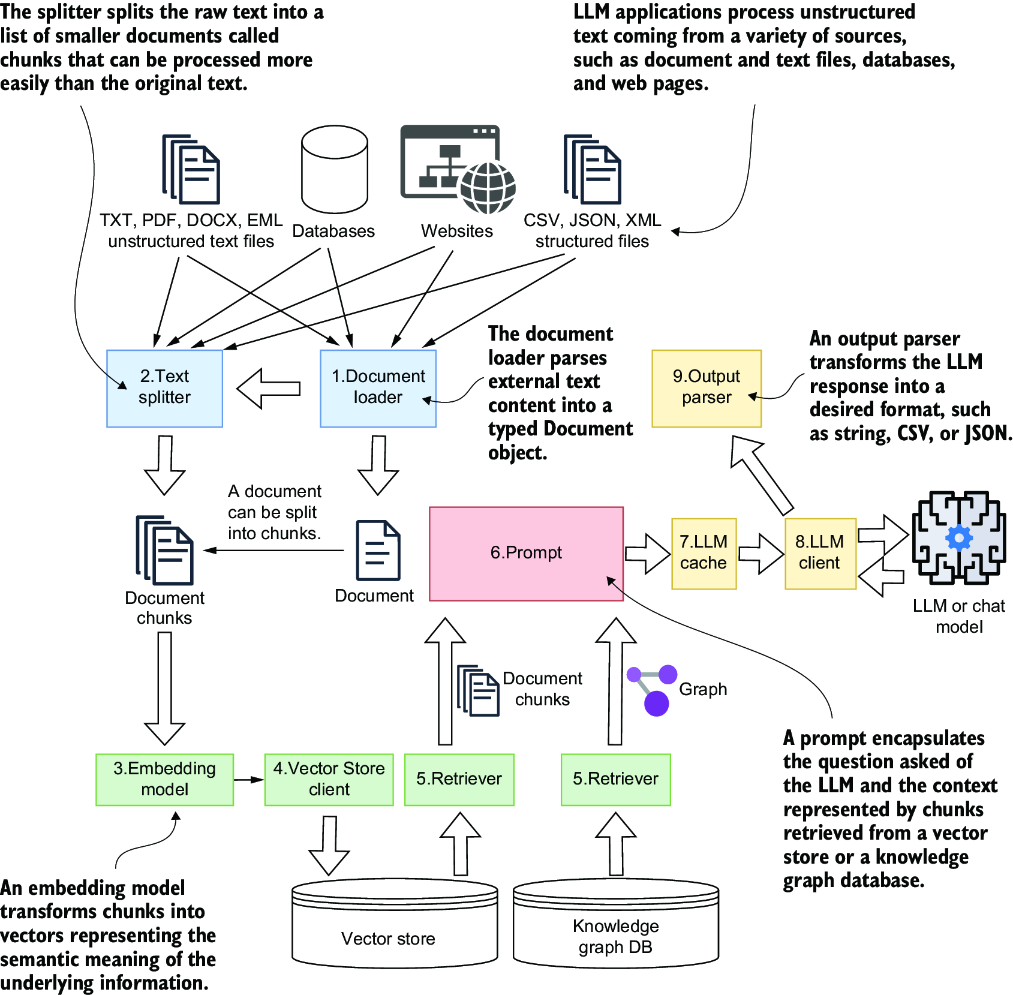
The diagram traces data from loader through splitter, embeddings, vector store, and retriever to the model; it also shows caching and output formatting. section 1.2.1
Make a first model call
With the Python packages langchain and langchain-openai installed and an OpenAI API key available, create `ChatOpenAI(model_name="gpt-5-nano", openai_api_key=OPENAI_API_KEY)`. Call `llm.invoke("Write a concise phishing reminder.")` and read `response.content`. This small call establishes the model interface before adding templates, retrieval, or chains. section 2.2 section 2.1
For larger workflows, prompt templates keep reusable instructions separate from inputs; `FewShotPromptTemplate` also separates examples from the surrounding prompt rather than hardcoding them together. Components sharing the Runnable interface can be composed with LangChain Expression Language (LCEL), including its pipe operator (`|`). A research summarization engine can connect web search, page summarization, and final-report generation as chains. section 2.5.5 section 1.7 section 4.0
Modular interfaces make it easier to replace a model, vector store, or data connector without redesigning the whole application. They do not make answers automatically reliable: retrieval still needs relevant source content, and a fixed chain cannot adapt its route as readily as a conditional workflow. LangGraph adds state and conditional edges when a research process needs to retry weak searches; LangSmith tracing helps inspect and troubleshoot a RAG chatbot. section 1.2 section 5.5.3 section 7.0


















