Agentic retrieval-augmented generation lets a model decide whether to retrieve, revise a query, and route across sources. That flexibility adds model calls and expands the verification surface. section 4.3.1
A governed pipeline separates corpus preparation from evidence assembly. Preparation records provenance, permissions, and versions while building indexes or navigation; assembly selects retrieval methods, reranks results, follows required relationships, and packages cited evidence. A demonstrated implementation uses query rewriting, hybrid search, fusion, and context assembly. Prefer deterministic lookup when the task supplies an exact key. section 4.3.1
Figure 4.3 RAG Pipeline from basic retrieval to governed compile and assemble paths. Provenance, version, permission, and source identifiers survive into the evidence package.
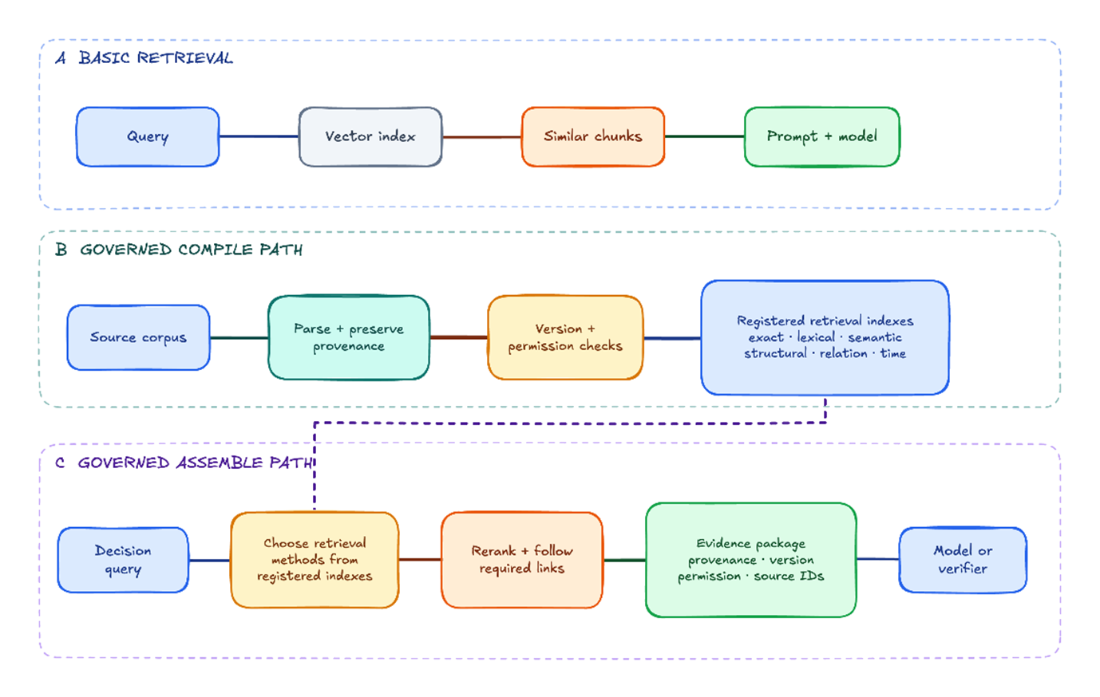
Trace how provenance, versions, permissions, and source identifiers carry through the governed retrieval pipeline into its evidence package. section 4.3.1








