Agentic workflow
An agentic workflow is a structured, multistep process in which one or more AI agents perform or coordinate actions toward an objective, often adapting to observations or results.
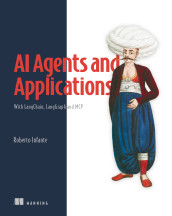
AI Agents and Applications
An agentic workflow is a structured, multistep application process in which a large language model orchestrates predefined components within explicit boundaries and managed state.
- How it is used
- Structures multistep LLM applications around predefined components, bounded decisions, and explicit state.
- How deep it goes
- Explains graph construction through typed state, nodes, edges, conditional routing, and execution-history inspection.
- Examples
- Illustrates request routing to a SQL database or REST API and a research workflow that loops between search and synthesis.
- What you can do after
- Apply it via LangGraph to construct and inspect a stateful workflow with conditional routing.
Read how AI Agents and Applications explains agentic workflow →
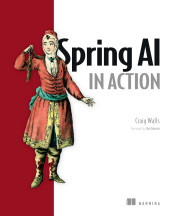
Spring AI in Action
An agentic workflow pattern is a design for organizing an AI agent's actions into a coordinated problem-solving process.
- How it is used
- Organizes augmented LLM capabilities into goal-oriented problem-solving workflows.
- How deep it goes
- Defines several patterns and begins implementation with prompt chaining, while stopping short of exhaustively implementing every pattern.
- Examples
- Uses prompt chaining, routing, parallelization, orchestrator-workers, and evaluator-optimizer as workflow patterns.
- What you can do after
- Apply agentic patterns through Spring AI’s ChatClient and compose foundational workflows into larger solutions.
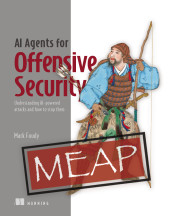
AI Agents for Offensive Security
A workflow in which AI agents and security tools pass information and decisions through ordered stages.
- How it is used
- Coordinates AI-assisted offensive security work across reconnaissance, triage, prioritization, testing, reporting, and escalation.
- How deep it goes
- Explains staged composition, artifact interfaces, orchestration, failure handling, safety gates, and observability rather than agent internals.
- Examples
- Uses reconnaissance observations flowing through triage and prioritization into testing, reporting, or escalation.
- What you can do after
- Build it from scratch as a multi-agent pipeline with explicit artifact handoffs, controls, and human oversight.
Read how AI Agents for Offensive Security explains agentic workflow →
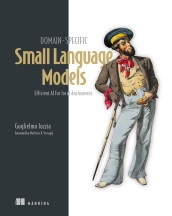
Domain-Specific Small Language Models
A multi-step model-and-tool interaction pattern where the model chooses tools, receives results, and iterates toward a final answer.
- How it is used
- Uses local-model conversations to let an LM Studio model call supplied Python functions as tools.
- How deep it goes
- Demonstrates a model.act call with a Python function; the tool-execution loop is not elaborated.
- Examples
- Uses a multiply function to answer a question about 123 multiplied by 456.
- What you can do after
- Apply it via LM Studio’s Python SDK to expose a Python function as a model tool.
Read how Domain-Specific Small Language Models explains agentic workflow →
Also covered in
- Designing AI SystemsIn early access (MEAP)
- Transformers in Action
- AI Agents in Action
- AI GovernanceIn early access (MEAP)
- First-Party Data Activation
- Spec-Driven DevelopmentIn early access (MEAP)
- Agent Design PatternsIn early access (MEAP)
- Financial AI in Practice
- Retrieval Augmented Generation, The Foundational IdeasIn early access (MEAP)
- Investing for Programmers
- Learn AI Data EngineeringIn early access (MEAP)
What to know first
- language modelA language model is a computational model that represents patterns in linguistic sequences to assign probabilities, predict, generate, or evaluate language.
- AI agentAn AI agent is a computational system that uses artificial intelligence to interpret information and select or perform actions toward goals while interacting with an environment.
- toolA software tool is a capability or utility that enables a person or system to perform a defined task or operation.
- promptA prompt is text or other input supplied to an AI model to provide instructions, context, or other information that guides its response or generated output.
Related concepts
- AI agentuses · An AI agent is a computational system that uses artificial intelligence to interpret information and select or perform actions toward goals while interacting with an environment.
- @Agentincludes · @Agent is an Embabel annotation that declares a class to be an agent and can assign it identifying metadata.
- small language modeluses · A small language model is a comparatively compact language model with limited parameters or capacity and typically lower computational and storage requirements than larger models.
- agent orchestrationconfigured by · Agent orchestration is the coordination of agents, their tasks, tools, and interactions to accomplish a larger objective or workflow.
- LangGraphimplemented by · LangGraph is a framework for building stateful, graph-structured workflows and applications, including those involving language models and agents.
- ReActused by · ReAct is an agent technique that iteratively interleaves reasoning, actions, and observations so results can guide subsequent actions.
Questions about agentic workflow
What is agentic workflow?
An agentic workflow is a structured, multistep process in which one or more AI agents perform or coordinate actions toward an objective, often adapting to observations or results.
Which Manning books explain agentic workflow?
AI Agents and Applications, Spring AI in Action, AI Agents for Offensive Security and Domain-Specific Small Language Models.
What should I know before learning agentic workflow?
Manning books that teach agentic workflow usually introduce language model, AI agent, tool and prompt first.
What kinds of agentic workflow are there?
Kinds of agentic workflow include @Agent.
What is agentic workflow also called?
Agentic workflow is also called agent workflow.
These guides are generated from the text of Manning books by Manning's knowledge graph and link to the sections they draw on. The full books are available on liveBook and at manning.com.