liveBook · Manning

Alerting

As explained in Cloud Observability in Action

An alert is a notification or triggered condition indicating that a monitored service or infrastructure condition requires attention.

Alerting automates checks for conditions that require attention and informs the person responsible for a service or infrastructure. Alerts may be triggered conditions, while alarms can group multiple alerts. section 7.0

Effective alerting connects operational signals to an incident workflow:

  • Monitor reachability, endpoint status, performance, or simulated user journeys. section 7.1.1
  • Compare observations with a manually observed or automatically detected healthy baseline. section 7.1.1
  • Notify the owner responsible for investigating and responding to abnormal behavior. section 7.0

Cloud-provider alerting

Cloud-native teams can use Amazon CloudWatch alarms with SNS email or SMS notifications, Azure Monitor Alerts with email, SMS, or push notifications, or Google Cloud alerting with notification types including email and Pub/Sub. Grafana can provide a unified view over some provider data sources. section 7.2.3
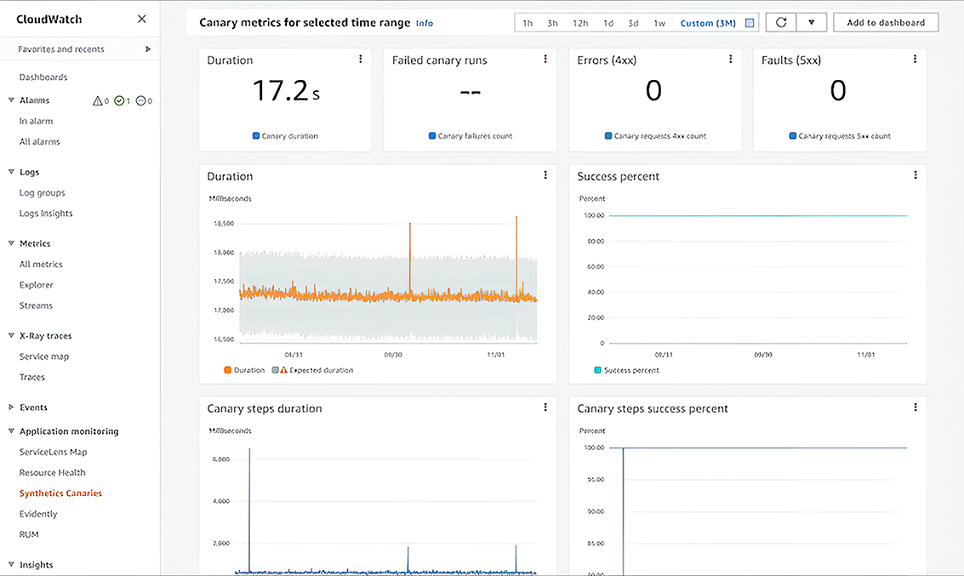
Figure 7.1 CloudWatch, an example of synthetic monitoring, tracking the availability of a website

Synthetic monitoring illustrates how automated checks can track website availability from an end-user perspective. section 7.1.1


How Cloud Observability in Action covers it

How deep it goes
Defines alerting, baselines, and monitoring approaches, then surveys Prometheus, Grafana, and cloud-provider offerings without implementation detail.
Examples
Uses endpoint checks, simulated user journeys, CloudWatch alarms, Azure Monitor Alerts, Google Cloud alerting, SNS, and Pub/Sub.
What it assumes
Assumes familiarity with monitored services and telemetry while introducing baselines, synthetic monitoring, and alerting terminology.
What you can do after
Operate alerting by selecting monitoring checks, establishing baselines, and routing notifications to responsible owners.
How it connects
Connects health monitoring, synthetic monitoring, anomaly detection, incidents, service ownership, and service-level objectives.

Also explained in

Compare how 10 books explain alerting →

Related concepts

This explainer was generated by Manning's knowledge graph from the text of Cloud Observability in Action. The section links point to the parts of the book it draws on.







