Alert fatigue is reduced attention to, or disregard for, security alerts caused by excessive alarms, especially false positives. As noisy detection erodes trust, analysts may overlook genuine threats and delay response. section 1.7
Reducing alert fatigue requires more than adding AI. Layer anomaly detection and threat intelligence with rules, signatures, behavioral analysis, and human oversight; refine models and improve data quality continuously. section 1.7 section 8.8
Measure and manage alert fatigue through operational targets:
- Track false-positive rates, true-positive detection, and incident response time rather than raw alert volume alone. section 10.4.3
- Set thresholds that balance false rejection, false acceptance, and equal error rates. section 8.8
- Prioritize incidents by risk so analysts focus on critical threats and reduce cognitive load. section 10.4.3
DataGuard Solutions
DataGuard Solutions faced many daily false positives, missed threats, and delayed responses. It targeted fewer than 500 false positives per day, a 90% true-positive detection rate, and a one-hour average response time. An AI anomaly-detection system using real-time threat intelligence learned benign behavior, reduced false positives, prioritized incidents, and improved response performance. section 10.4.3
Figure 10.3 The left side shows the effectiveness of the AI dashboard, presenting daily false positive rates, true positive detection rates, and the average incident response time. On the right is its effectiveness after implementing an AI-driven solution.
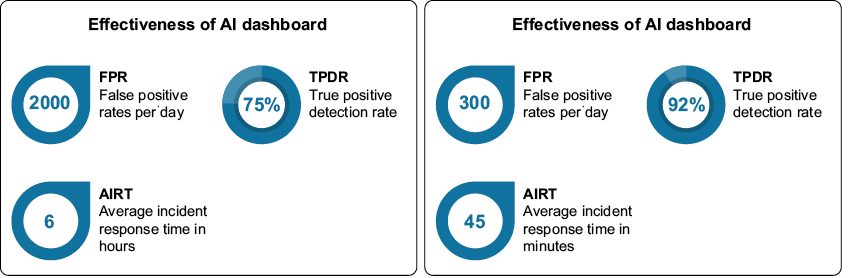
Compare the before-and-after dashboard to connect false-positive rates, true-positive detection, and incident response time with operational improvement. section 10.4.3


