Angle-based outlier detection (ABOD) identifies unusual observations by measuring how much angles vary between each observation and pairs of other observations. Central points produce widely varying angles; points outside the main data body produce more consistent angles. Distances contribute secondarily, helping distinguish strong outliers when angle variation alone is similar. section 6.5
A practical ABOD interpretation follows these steps:
- For each point, form angles with every pair of other points and assess the variation of those angles. section 6.5
- Treat large angular variation as evidence of centrality and narrow variation as evidence of an outlying position. section 6.5
- Use distance as a minor additional signal when similarly varying angles do not separate outliers clearly. section 6.5
- Account for computational cost: the full method is O(n3), while fastABOD samples the data to reduce the workload. section 6.5
Figure 6.11 The idea behind ABOD is shown with a 2D dataset. ABOD works by, for each point, finding the angle between it and every other pair of points. Inliers will have a large variance of angles, while outliers will have a narrow variance of angles. The left and middle pane show two angles formed around point A in the center of the data. This point is the center of angles with a diverse range of sizes. The right pane shows an example of an angle formed around an outlier point, point B. The set of angles formed with this point at the center will have a small range of sizes.
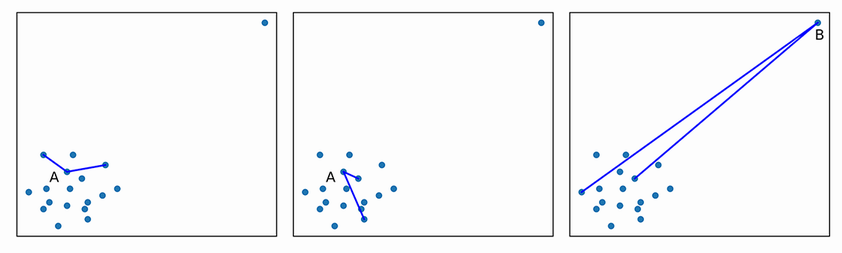
A two-dimensional geometric illustration contrasts a central point with diverse angle sizes against an outlier with narrowly varying angles. section 6.5
