An artificial ant is a graph-traversing agent in Ant Colony Optimization. Like a foraging ant, it explores routes and leaves digital pheromone trails that help later ants favor successful paths. section 8.0 section 8.1
On a route-finding task, an ant:
- Chooses among unvisited nodes using weighted probabilities based on pheromone and heuristic desirability; shorter distances have higher heuristic values. section 8.1
- Completes a tour, then contributes to the feedback loop: traversed paths receive pheromone while trails evaporate. section 8.1
A nest and three crumbs
Starting at node A, the ant chooses among crumbs B, C, and D. With initial pheromone levels equal, the shorter route to B has greater heuristic desirability; after a 60-mile tour, traversed paths gain pheromone and ignored paths lose it through evaporation. section 8.1
Figure 8.1 Initializing the graph for Ant Colony Optimization. The left graph shows the physical distances (d) between the Nest and the Crumbs, which determines the heuristic desirability. The right graph shows the baseline digital pheromone weights, initialized to a flat 1 across all paths before the swarm is deployed.
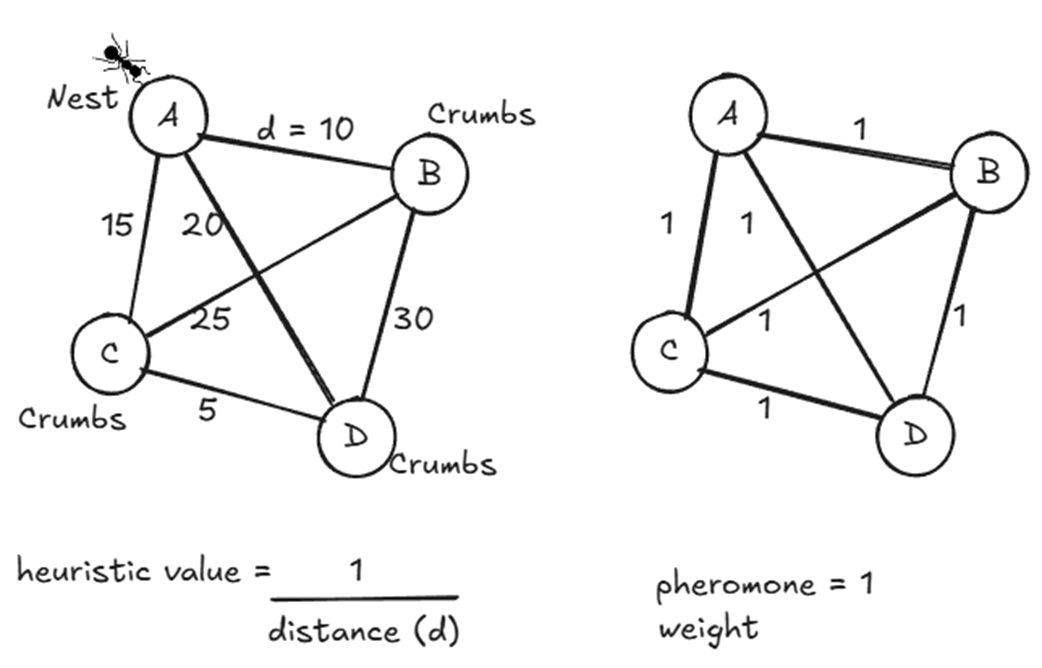
Compare the graph’s distances with its initially uniform pheromone weights. section 8.1


