An approximate distribution q(x) stands in for a target posterior p(x) when the target is difficult to compute directly. Variational inference chooses q from a tractable family with trainable parameters, then adjusts those parameters to make q close to p. Unlike a sample-based approximation, the result is itself a distribution that can be evaluated or optimized. section 3.0
One objective is reverse KL divergence, KL(q‖p) = E_q[log(q(x)/p(x))]. Minimizing it turns posterior approximation into an optimization problem. KL is nonnegative and reaches zero when q equals p. The choice of direction matters: reverse KL tends to concentrate on one mode of the target, while forward KL tends to cover more of its support. section 3.1
A normal approximation
Let the target be p(x) = N(0, 1) and the approximation be q(x) = N(μ, 4). Holding q’s variance fixed and varying μ from −4 to 4 changes KL(q‖p); it is smallest at μ = 0, where the two means agree. Matching means does not make the distributions identical, because their variances still differ. section 3.1
Figure 3.2 Forward KL (left) q(x) overestimates the support, while reverse KL (right) q(x) locks onto a mode.
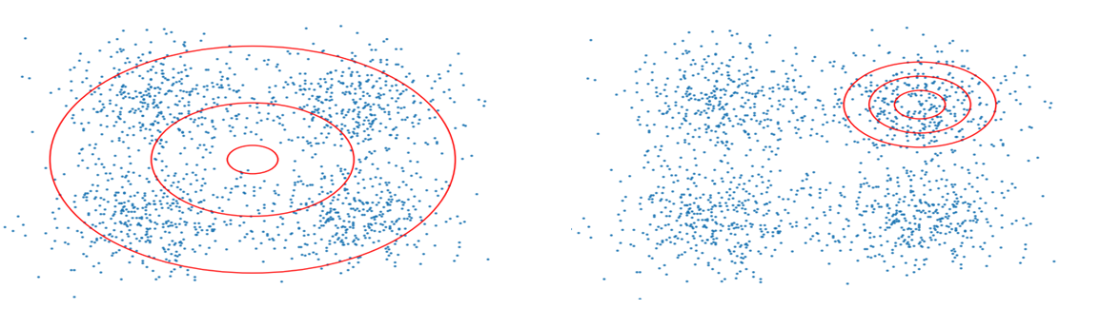
Compare how the direction of KL divergence changes the approximation: forward KL spreads across support, whereas reverse KL locks onto a mode. section 3.1
The tractable family determines what q can represent. A mean-field approximation makes q fully factorized, speeding computation but restricting dependence between variables. Its parameters can be learned by maximizing an evidence lower bound (ELBO). In amortized variational inference, a parameterized function instead maps observations to approximate-posterior parameters. Approximate distributions also appear when deriving a lower bound for mutual-information maximization. section 3.0 section 3.6 section 11.7 section 3.4


