An architectural decision addresses a problem by choosing among candidate solutions and recording why one was selected. It includes the problem, motivation, cause, candidate solutions, decision, and rationale. The chosen solution changes architectural elements, relationships, rules, or constraints; together, decisions compose the architecture. section 3.4.1
When making architectural decisions, consider:
- Which people should decide: options include a separate decision-maker, an architect embedded in a team, team members, or implicit decision-making. section 3.4.2
- Whether decisions meet affected people’s needs, can be made quickly, and have the buy-in of those affected. section 3.4.2
- Whether to solve a present problem or an evidenced future one; start with the simplest architecture that works and evolve it as needs arise. section 3.4.3
Choosing a layered architecture
A decision to use layers establishes elements such as web/api, domain, and infrastructure, plus a constraint that each layer depends only on the layer immediately below. The decision adds structure and rules to an initially blank architecture. section 3.4.1
Figure 3.17 An architecture is the composition of design decisions, each of which consists of the problem, motivation, cause, candidate solutions, chosen solution, and rationale. The chosen solution modifies the architecture by adding, deleting and modifying elements, relations, rules, and constraints.
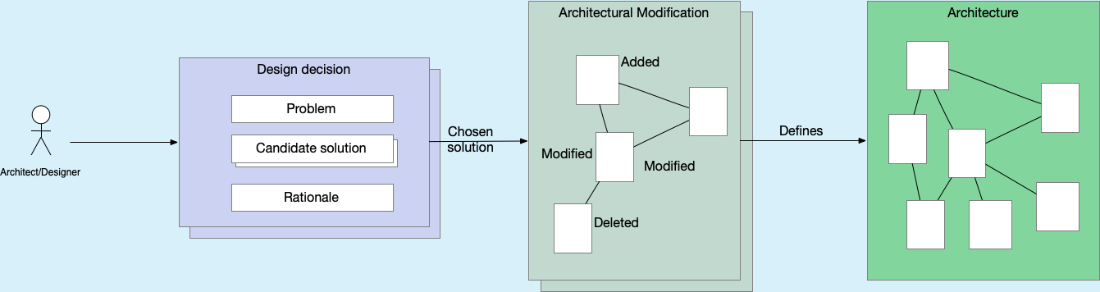
Diagram the parts of a decision and how its chosen solution changes architectural elements, relationships, rules, and constraints. section 3.4.1





