Argo is an open-source Kubernetes tool suite for deploying and running applications and workloads. Its core projects cover declarative GitOps delivery, progressive delivery, event-driven dependencies, and container-native workflows. section 8.4
Use the core projects for distinct operational roles:
- Argo CD manages application definitions, configurations, and environments declaratively in Git, with automated and auditable deployment lifecycle management. section 8.4
- Argo Rollouts adds Kubernetes controllers and custom resources for blue-green and canary deployment, analysis, experimentation, and progressive delivery. section 8.4
- Argo Events resolves dependencies from sources such as webhooks, S3, schedules, and streams before triggering Kubernetes objects. section 8.4
- Argo Workflows orchestrates compute-intensive container jobs as Kubernetes custom resources, using sequential steps or task dependency graphs. section 8.4
For machine learning pipelines, Argo Workflows connects independently implemented stages into an end-to-end Kubernetes workflow. Each step can run in a separate container; workflows can express parallel work with a DAG or branch conditionally from a step result. Argo Events can trigger these workflows from external events. section 8.4 section 9.4
Submitting and inspecting a workflow
Define a Workflow with an entrypoint template, container image, and command, then submit it with kubectl. Inspect workflow status, select its Pods by workflow label, and retrieve container logs. Resource templates can create Kubernetes objects such as ConfigMaps; script templates can run embedded Python. A diamond DAG makes two tasks depend on A and a final task depend on both; a coin-flip workflow conditionally runs either branch. section 8.4.1
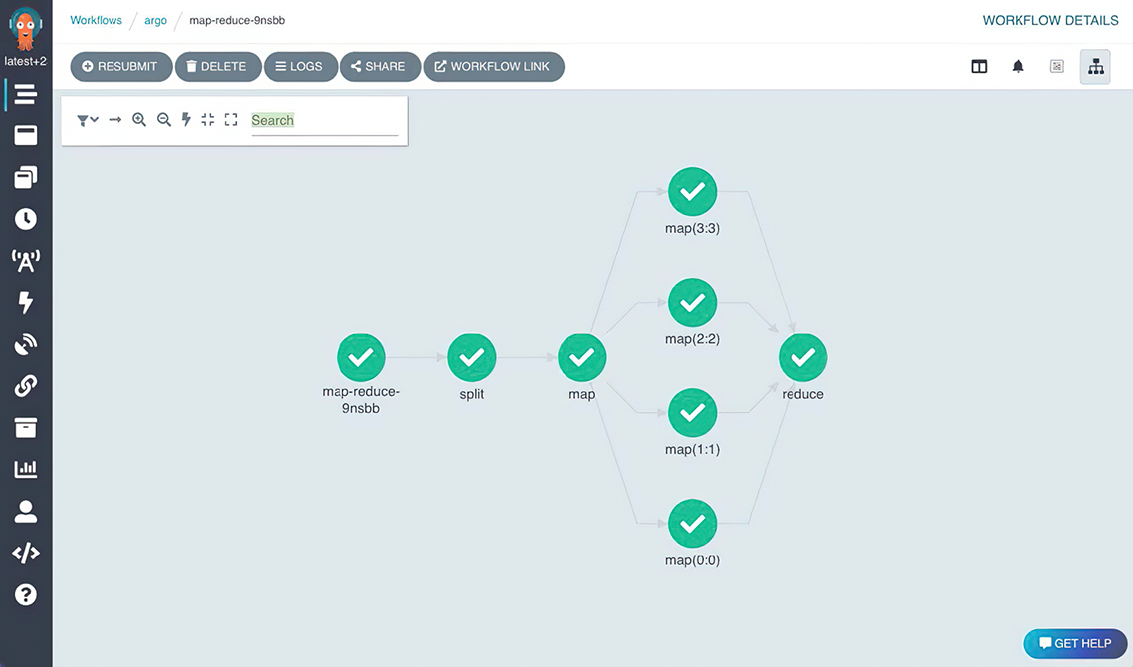
Inspect the workflow UI’s DAG view to see a map-reduce-style container workflow and its task relationships. section 8.4.1
An end-to-end machine learning workflow can sequence data ingestion, distributed training, and model serving components. Step memoization avoids repeating a time-consuming, redundant ingestion step in later executions. section 9.4 section 9.5



