An A2A artifact represents a task output. A Task can contain zero or more Artifacts, and each Artifact consists of one or more Parts. A Part holds text, raw bytes, a file URI, or JSON data. section 10.1.3
Figure 10.5 Simplified UML class diagram of the important A2A elements used in a task lifecycle (this is different from our typical UML class diagrams, which we use as build plans for our implementations)
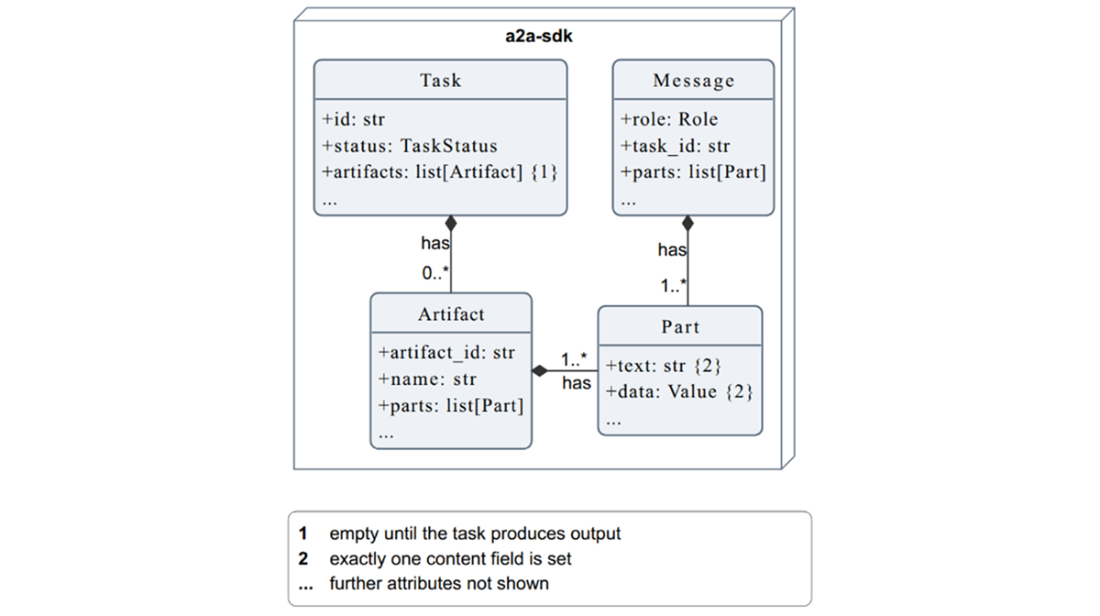
Use the diagram to see how Artifacts relate to Tasks and Parts in the A2A task lifecycle. section 10.1.3
In an executor workflow, TaskUpdater publishes status updates and posts the final Artifact. On success, the Artifact is uploaded to the Task and becomes available to the client when the Task reaches a terminal state; on failure, an error is sent in a Message. section 10.3.1
Hailstone task
A client can send the instruction “Compute the Hailstone sequence starting at 6” in a Message. After the remote agent completes the task, its result is returned as an Artifact attached to the Task. section 10.1.3 section 10.3.1