A neural network is a layered model that transforms inputs through chained computations. Each layer performs matrix multiplication followed by a nonlinear activation, allowing the network to model complex functions. section 13.3.1
Neural networks are especially useful for structured data whose important relationships a simple covariance function cannot capture. In a combined model, the network processes the input before a Gaussian process applies its mean function and kernel. section 13.3 section 13.3.1
A forward pass works by:
- Passing the input through multiple computational layers. section 13.3.1
- Applying a nonlinear activation after each layer’s matrix multiplication. section 13.3.1
- Producing a flexible numerical representation that can expose important features of structured data. section 13.3.1
Housing-price inputs
A kernel that compares houses only by front-door color can assign inappropriate similarities. A neural network can instead process structured housing information, such as relevant features, into numerical values that a Gaussian-process kernel can use. section 13.0 section 13.3.1
Figure 13.9 A neural network is a collection of layered computations. By chaining multiple layers of computations together, a neural network can model complex functions well.
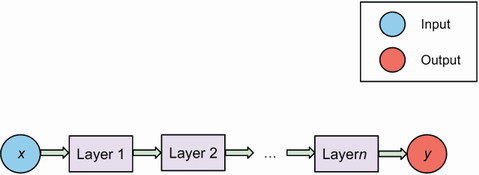
Visualizes a neural network as chained layered computations for modeling complex functions. section 13.3.1
Figure 13.10 Combining a neural network with a GP. The neural network processes the structured data input x first and then feeds the output to the mean function and the kernel of the GP.
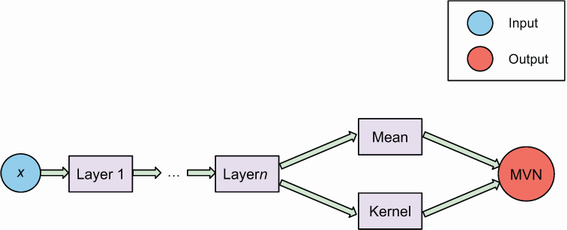
Shows the neural network transforming input before the Gaussian process mean function and kernel receive it. section 13.3.1



