Context isolation keeps one agent’s working history out of another agent’s context. In a multi-agent system, this determines whether specialists see earlier steps or receive only a task and return a result. It is a separate choice from who decides which agent runs next. section 9.2
In the Agent as Tool pattern, an orchestrator delegates a subtask to a child agent. The AgentTool adapter receives the parent’s context but does not pass it to the child. It passes only a request string; the child runs in a new context and returns its final result. section 9.4.2 section 9.4.3
Choose the context boundary according to what the next agent needs:
- Use an isolated child when the orchestrator needs a specialist’s answer, not its searches, tool calls, or reasoning steps. This keeps the parent context smaller. section 9.4.3
- Use a shared-context workflow when later agents need intermediate work. A Workflow can instead create separate contexts when that better fits the pipeline. section 9.2 section 9.4.3
- Plan to inspect a child separately when debugging: its internal steps are not visible in the parent context. section 9.4.3
Delegating research
An orchestrator requests research from a specialist. The specialist may make several web searches, but the orchestrator receives only the final research result. In a shared sequential workflow, those searches and the agents’ later analysis would accumulate in the same context. section 9.4.3
Figure 9.8 Agent as Tool: the child agent runs in an isolated environment and returns only the final result.
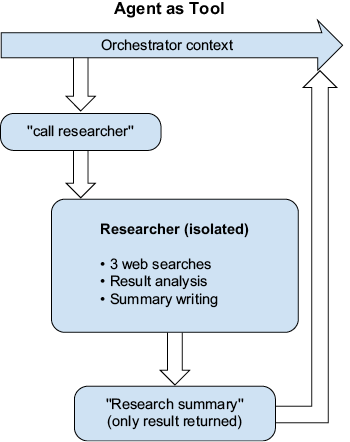
The diagram shows the boundary between an orchestrator’s context and an isolated child that returns only its final result. section 9.4.3







