Attribute-based access control (ABAC) makes authorization decisions from attributes such as a user’s department or location. In catalog architectures, it helps govern who can read, write, or administer particular tables and namespaces, alongside identity-provider integration and RBAC. section 7.2.2
Use ABAC as part of a layered governance design:
- Connect catalog identities and access contexts to enterprise providers such as OAuth, LDAP, SAML, or SSO. section 7.2.2
- Coordinate policy modeling with query-engine enforcement: row-level and column-level rules are typically applied at query time by engines such as Trino, Dremio, or Snowflake. section 4.3.3
Figure 7.6 Catalogs can have different levels of access control, allowing you to control who has access to which namespaces or tables.
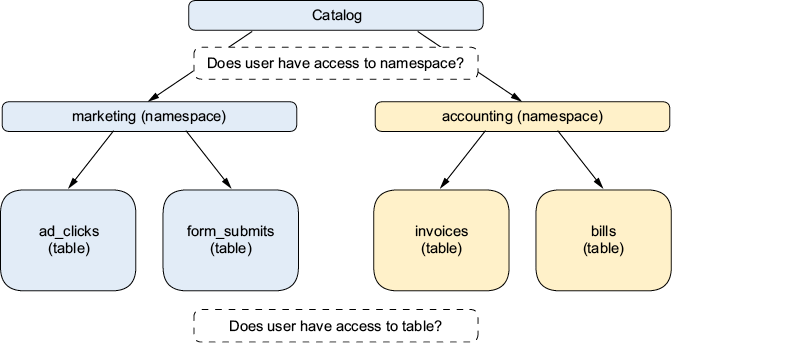
Use the access-control diagram to compare how catalogs restrict access to namespaces and tables. section 7.2.2



