A growing service may need to give contractors limited support access, restrict sales representatives to accounts in their region, and let auditors see who has access and why. Scattered application checks make those decisions difficult to review and keep consistent. An authorization model provides a way to represent authority and determine how permissions are assigned or evaluated. section 5.0 section 4.6
Models differ in what they use to represent authority: lists of principals, roles, attributes, or relationships. The choice shapes how rules are expressed and how easily access can be understood, changed, and trusted. It also informs the surrounding separation of enforcement, policy evaluation, policy management, and contextual data. section 4.6
Common approaches offer different starting points:
- Access control lists (ACLs) attach permissions to a resource, identifying principals and their allowed or denied actions. section 5.1
- Role-based access control (RBAC) assigns access through roles. ACLs and RBAC are static starting points for organizing permissions. section 5.0
- Attribute-based access control (ABAC), relationship-based access control (ReBAC), and policy-based access control (PBAC) support more dynamic authorization. Changing conditions can include time, device state, resource relationships, and external obligations. section 5.3
A shared folder
A marketing folder has an ACL listing Alice, Bob, and the Marketing team with their respective permissions. Alice can write and Bob can read; Carol, who is not on the Marketing team, cannot read. The decision depends on the resource’s list rather than Alice’s organizational title. section 5.1
Static assignments can be straightforward, but they may not capture conditions that change between requests. Dynamic models offer greater flexibility and expressiveness at the cost of complexity. Models can also complement one another: relationships can describe collaboration, while attributes capture conditions such as time or device state. Relationship-based decisions require maintained relationship data and enough visibility to trace and audit access. section 5.3 section 6.1.3
A model choice is also an architectural and governance choice. Consider where enforcement occurs, how portable policies need to be, who will maintain them, and how much complexity the team can support. In a multi-tenant service, layered authorization can separate platform and tenant responsibilities while allowing tenant customization within shared constraints; consistent identity and tenancy data support decisions across those layers. section 8.5.6 section 13.8
Figure 8.3 Strength map comparing five policy languages and frameworks (XACML, OPA/Rego, OpenFGA, AWS IAM, and Cedar) across the four PARC elements and portability. Darker shading indicates stronger, more native support for that element; lighter shading indicates partial or minimal support. This visual emphasizes how each system’s design highlights different aspects of authorization, from attribute-rich context handling to typed principals and explicit resource modeling.
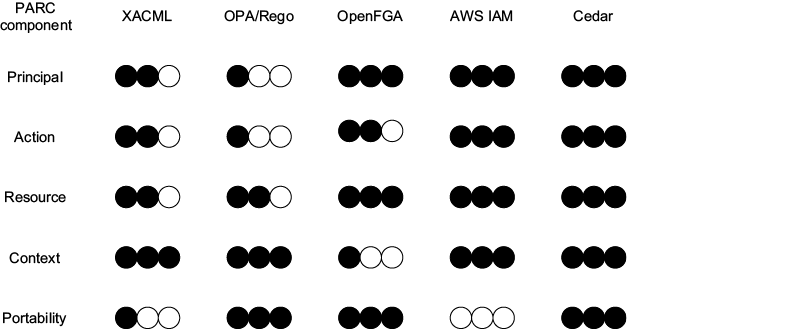
Compare how policy languages and frameworks emphasize different authorization elements and portability when selecting an implementation. section 8.5.6

