Dot notation
Dot notation uses periods to separate names in qualified or hierarchical references, commonly to access members or nested fields.
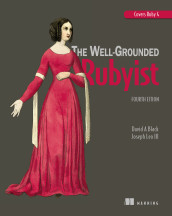
The Well-Grounded Rubyist, Fourth Edition
The dot operator is Ruby syntax that sends the expression on its right as a message to the object on its left.
- How it is used
- Uses dotted notation as the normal form for sending messages to Ruby objects and calling their methods.
- How deep it goes
- Explains receivers, method calls, arguments, and implicit `self`, while deferring detailed treatment of `method_missing`.
- Examples
- Demonstrates string conversion, an `Object.new` receiver with a `talk` method, and calls with and without an explicit receiver.
- What you can do after
- Practice/perform Ruby method calls with explicit or implicit receivers and distinguish a bare method call from a same-named local variable.
Read how The Well-Grounded Rubyist, Fourth Edition explains dot notation →
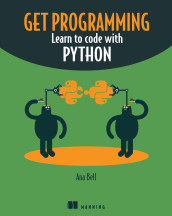
Get Programming: Learn to code with Python
Dot notation is Python syntax that accesses an operation or attribute through an object by placing a dot between the object and the member name.
- How it is used
- Uses object-centered syntax to access type-specific operations and properties in Python.
- How deep it goes
- Explains object properties, operations, type inference, and explicit class calls, while deferring deeper object-oriented implementation details.
- Examples
- Uses lower(), upper(), replace(), append(), keys(), and Circle radius methods as concrete examples.
- What you can do after
- Apply it in Python to call operations on strings, lists, dictionaries, and custom objects.
Read how Get Programming: Learn to code with Python explains dot notation →

MongoDB 8.0 in Action, Third Edition
Dot notation is MongoDB query syntax that accesses fields in nested documents or fields across array elements by joining path components with periods.
- How it is used
- Filters nested documents and array contents during MongoDB queries.
- How deep it goes
- Explains nested paths, array positions, quoting, and $elemMatch, while stopping short of broader query optimization.
- Examples
- Uses airline fields, route prices, customer accounts, tier details, and indexed array elements as query examples.
- What you can do after
- Apply it via MongoDB query filters for nested fields, arbitrary array elements, indexed elements, and same-element conditions.
Read how MongoDB 8.0 in Action, Third Edition explains dot notation →

D3.js in Action, Third Edition
Dot notation is JavaScript property access syntax that places a property name after an object and a period.
- How it is used
- Uses property access to read and transform fields in JavaScript objects and datasets.
- How deep it goes
- Defines dotted access, contrasts bracket notation, and applies both within dataset iteration.
- Examples
- Uses employee objects, an employee dataset, property conversion, name extraction, filtering, and record lookup.
- What you can do after
- Apply it via JavaScript to read and update object properties while iterating through datasets.
Read how D3.js in Action, Third Edition explains dot notation →

Data-Oriented Programming: Reduce software complexity
Dot notation is syntax for accessing a named property or member through a dot-separated expression.
- How it is used
- Contrasts concise property access with generic key-based access when applying data-oriented programming to maps.
- How deep it goes
- Defines dot notation and contrasts it with map access, but defers detailed language semantics and implementation internals.
- Examples
- Uses user.email, member.email, nested catalog paths, and Lodash _.get and _.at examples.
- What you can do after
- Evaluate when concise attribute syntax or generic path-based access better fits a data representation.
Read how Data-Oriented Programming: Reduce software complexity explains dot notation →
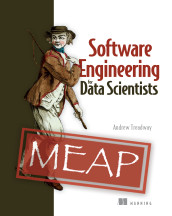
Software Engineering for Data Scientists
Dot notation is syntax that accesses an object's attributes or methods by placing a dot between the object expression and member name.
- How it is used
- Uses dots to inspect model configuration and retrieve data held by Python objects in data-science workflows.
- How deep it goes
- Defines the object.attribute pattern and demonstrates model and class examples without descending into attribute lookup internals.
- Examples
- Demonstrates RandomForestClassifier configuration, customer_obj.train_data, and chained pandas column transformation.
- What you can do after
- Apply it by reading attributes from scikit-learn models and custom Python objects.
Read how Software Engineering for Data Scientists explains dot notation →

Django in Action
Dot notation is syntax that accesses attributes, collection items, dictionary values, or no-argument callables through period-separated names.
- How it is used
- Connects Django template variables with nested object, dictionary, sequence, and callable data during rendered-page construction.
- How deep it goes
- Explains four lookup forms and demonstrates loop usage, but stops short of detailed lookup precedence or error behavior.
- Examples
- Uses person attributes, dictionary keys, fruit indexing, no-argument methods, and instrument lists rendered as HTML.
- What you can do after
- Apply it via Django templates to display context data and fields while iterating over collections.

Learn Rust in a Month of Lunches
Dot notation is Rust syntax that accesses a tuple element or object member by placing a period before its selector.
- How it is used
- Uses periods to select tuple elements, access struct fields, and call methods while keeping reference-heavy syntax readable.
- How deep it goes
- Explains tuple selectors, struct fields, method calls, and automatic dereferencing, but stops short of broader operator rules.
- Examples
- Demonstrates tuple positions, String emptiness checks through nested references, and struct field access through a borrowed value.
- What you can do after
- Apply it via Rust syntax to access tuple elements, read struct fields, and call methods without manually writing every dereference.
Read how Learn Rust in a Month of Lunches explains dot notation →

Pandas Workout: 200 exercises to make you a stronger data analyst
Dot notation is attribute-access syntax that can retrieve a pandas column when its label is a valid Python identifier and does not conflict with an attribute.
- How it is used
- Uses concise attribute-style expressions to retrieve pandas DataFrame columns.
- How deep it goes
- Defines column access, contrasts row indexing, and stops short of broader pandas attribute mechanics.
- Examples
- Uses df.colname, df['x'], df.loc['x'], and df.iloc[0] to contrast column and row retrieval.
- What you can do after
- Apply it via pandas to retrieve compatible DataFrame columns and choose bracket notation for unsupported labels.
Read how Pandas Workout: 200 exercises to make you a stronger data analyst explains dot notation →

The Quick Python Book, Fourth Edition
Dot notation is syntax that accesses an attribute or method by placing its name after an object and a period.
- How it is used
- Accesses fields, methods, and imported module functions in everyday Python expressions.
- How deep it goes
- Defines attribute and method syntax through examples, then connects it to initialization, inheritance, and immutable strings.
- Examples
- Demonstrates circle fields, complex-number parts, math functions, list methods, inherited movement, and string capitalization.
- What you can do after
- Apply it to read and assign attributes, call methods, and invoke functions through imported modules.
Read how The Quick Python Book, Fourth Edition explains dot notation →
Also covered in
- Grokking Relational Database Design
- Clojure: The Essential Reference
- Authorization in Action
- Functional Programming in Scala, Second Edition
- Rust in Action: Systems programming concepts and techniques
- The Design of Web APIs, Second Edition
- Tiny Python Projects: Learn coding and testing with puzzles and games
What to know first
- functionA function is a callable unit of program code that performs a computation or operation, can accept inputs, and may produce a result or side effect.
- classA class is a programming-language construct that defines a type’s structure and behavior and provides a basis for creating or representing objects.
- arrayAn array is an ordered collection of elements organized in one or more dimensions and accessible by position or index.
- attributeAn attribute is a named property or piece of information associated with an entity, object, or structured data item.
Related concepts
- attributeuses · An attribute is a named property or piece of information associated with an entity, object, or structured data item.
- dereferencingimplements · Dereferencing is the operation of following a pointer or reference to access the object or value it designates.
- atomic typeuses · An atomic type is a type whose supported accesses and operations are indivisible with respect to concurrent execution and provide defined synchronization semantics.
- callcontrasts with · A call is an invocation that requests execution of a function, routine, command, or tool, optionally supplying arguments.
- predictionuses · A DSPy object that stores a language model's outputs according to a signature and exposes its output fields for access.
- square bracketsalternative to · Square brackets are paired punctuation marks used in programming-language syntax to delimit expressions or constructs, including indexing and collection literals.
Questions about dot notation
What is dot notation?
Dot notation uses periods to separate names in qualified or hierarchical references, commonly to access members or nested fields.
Which Manning books explain dot notation?
The Well-Grounded Rubyist, Fourth Edition, Get Programming: Learn to code with Python, MongoDB 8.0 in Action, Third Edition, D3.js in Action, Third Edition, Data-Oriented Programming: Reduce software complexity, Software Engineering for Data Scientists, Django in Action, Learn Rust in a Month of Lunches and 2 more.
What should I know before learning dot notation?
Manning books that teach dot notation usually introduce function, class, array and attribute first.
What is the difference between dot notation and call?
Dot notation uses periods to separate names in qualified or hierarchical references, commonly to access members or nested fields. A call is an invocation that requests execution of a function, routine, command, or tool, optionally supplying arguments.
What is dot notation also called?
Dot notation is also called dot syntax.
These guides are generated from the text of Manning books by Manning's knowledge graph and link to the sections they draw on. The full books are available on liveBook and at manning.com.