When an autonomous agent and a robot scheduler make decisions independently, each can act correctly while a critical component still misses its deadline. Without a connected audit trail, a plant manager may be unable to reconstruct why the handoff failed. Auditability makes the decision chain inspectable across those boundaries, not just within each system. section 1.5
An agentic audit trail is a reconstructable evidence record linking an autonomous interaction to its intent, context, authority, constraints, system invocation, outcome, retry history, and recovery path. It explains why an action occurred, not merely which technical call was made. section 6.3.3
A governed scheduling override
A material-flow agent detects that a contract-critical component needs a robot ahead of another part. With documented authority, it requests a scheduling override; an external policy service evaluates the request rather than leaving approval to the agent. Explicit authority, policy checks, and a connected decision record make the coordination accountable across the agent and scheduler. section 1.5
Auditability also depends on how integrations handle uncertainty. If confirmation is lost, an agent retry can create a duplicate business action or split evidence across cases. A governed wrapper checks the record for the contract instance before another attempt: return the previous outcome if the effect exists, permit a controlled retry if it does not, and compensate, defer, or escalate if it cannot be confirmed. section 6.3.3
Figure 6.3 Why integration uncertainty requires governed wrappers. Without a wrapper (left), a confirmation timeout drives the agent to retry, and the enterprise sees a duplicate business effect with no linked evidence. With a governed wrapper (right), the retry is resolved against the prior effect recorded for the conversational contract instance, so uncertainty is absorbed at the boundary rather than leaking into the agent loop.
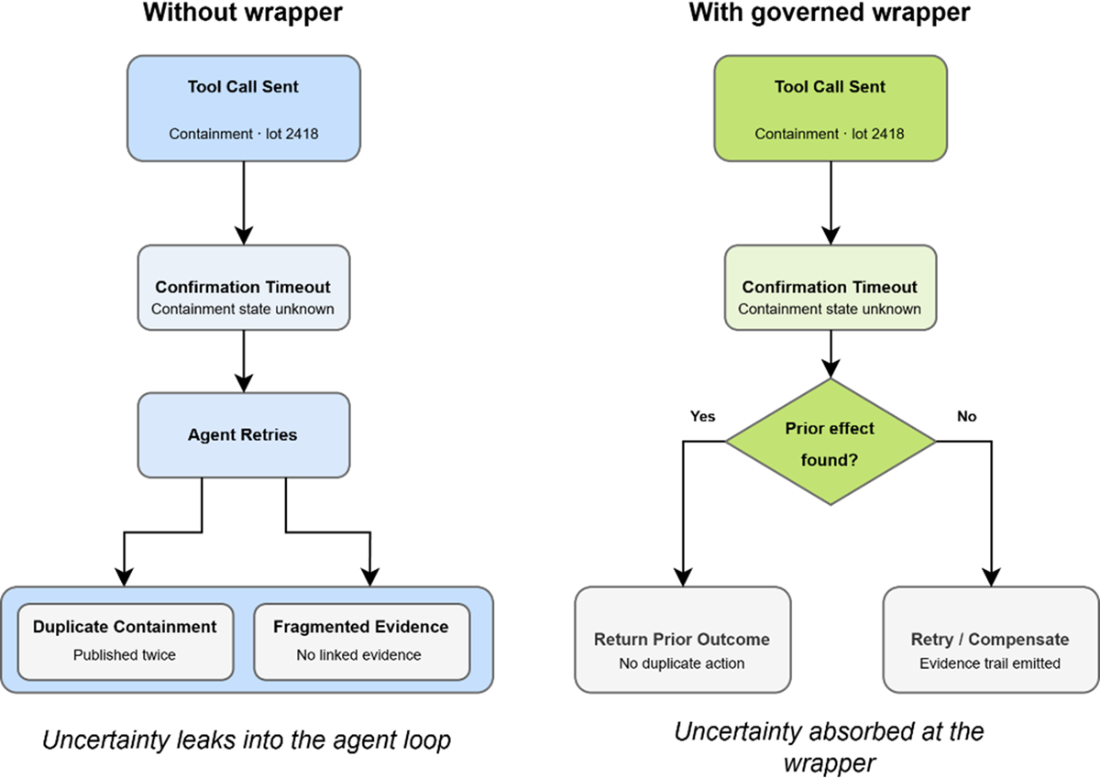
Compare an ungoverned retry with a wrapper that resolves uncertainty against the prior business effect. section 6.3.3
Anchor the idempotency key to the contract instance and an enterprise-issued identifier for the intended business effect, rather than letting the agent invent it. Governed interfaces should also specify what an agent may request, whose authority applies, and what audit trail is required. Delegation contracts can define escalation protocols alongside the trail, so oversight has a clear boundary. section 6.3.3 section 1.5.1 section 2.4








