liveBook · Manning

Automated testing

As explained in Effective Behavior-Driven Development

The execution of software tests by programmed tools or scripts rather than manually.

Automated testing turns formulated BDD scenarios into executable tests. Scenario tools invoke team-written automation code, making business-readable cases repeatable. section 1.3.4

Running relevant scenarios during development gives fast feedback and a safety net against regressions. Because the tests run during builds, they also help keep behavior documentation reliable. section 1.3.4 section 5.3.7

Figure 1.3 The BDD cycle is the outer loop – write a failing scenario, get the scenario to pass, then refactor. We enter the inner, TDD cycle to implement the code needed to move from a failing scenario to a passing scenario.
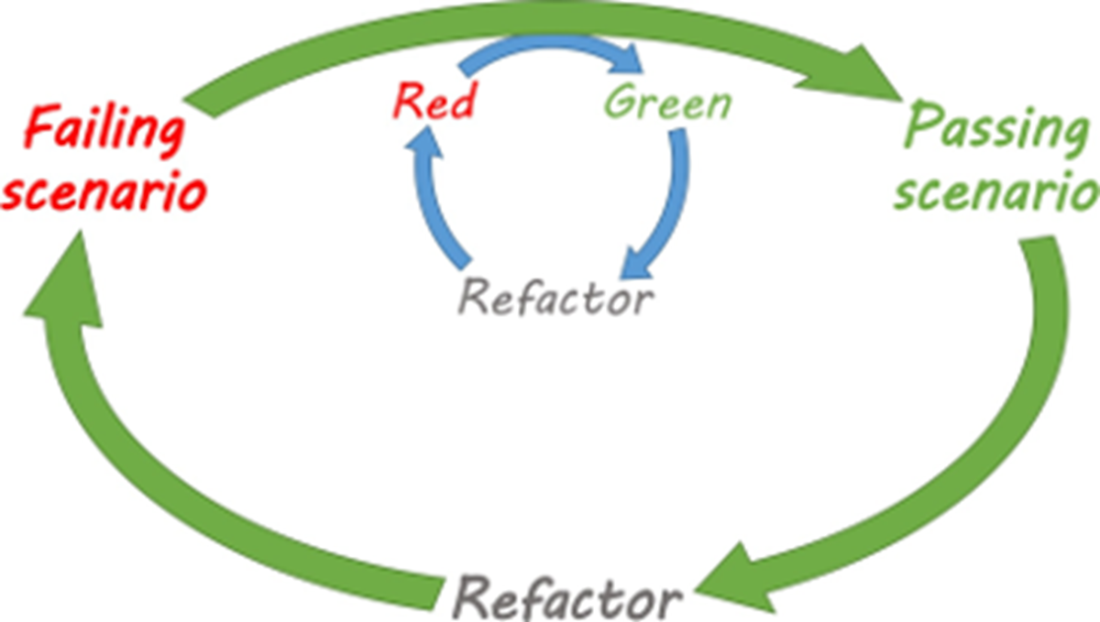
The cycle shows how a failing scenario guides implementation until it passes, followed by refactoring. section 1.3.4

A collected order

Automation code can prepare an order in the collected state to support a scenario stating that the customer's order has been collected. section 1.3.4


How Effective Behavior-Driven Development covers it

How deep it goes
Details how scenario tools invoke team-written automation code and follows a red-green-refactor cycle without specifying tool internals.
Examples
Uses a collected-order scenario and a failing-to-passing scenario cycle.
What it assumes
Assumes examples have already been formulated as scenarios before automation begins.
What you can do after
Diagnose regressions by using failing tests to distinguish requirement contradictions from implementation defects.
How it connects
Links BDD scenarios with examples, requirements, and TDD-driven implementation.

Also explained in

Compare how 4 books explain automated testing →

Related concepts

This explainer was generated by Manning's knowledge graph from the text of Effective Behavior-Driven Development. The section links point to the parts of the book it draws on.