An autonomous access point (AP) is a self-contained wireless unit that independently handles wireless operations, including client authentication and data encryption. It does not rely on an external wireless LAN controller (WLC). section 19.2.1
Key operating characteristics:
- Each AP operates as a standalone entity and requires separate configuration and management. section 19.2 section 19.2.1
- APs commonly connect to the wired LAN through trunk links because multiple SSIDs map to separate wired VLANs. section 19.2.1
- A dedicated management VLAN separates AP management traffic from user data and supports device administration. section 19.2.1
- Administrators configure APs individually through the console, Telnet, SSH, or a web browser using HTTP/HTTPS. section 19.2.1
- Individual management suits small deployments but becomes inefficient beyond roughly 5 to 10 APs and impractical in larger networks. section 19.2.1
Two-SSID deployment
A small LAN can use two autonomous APs to provide two extended service sets (ESSs). One SSID maps to VLAN 10 for employees, another maps to VLAN 20 for guests, and VLAN 99 carries AP management traffic over trunk links. section 19.2.1
Figure 19.5 Two autonomous APs providing two ESSs for clients. Autonomous APs connect to the wired LAN via trunk links to support multiple SSIDs/VLANs.
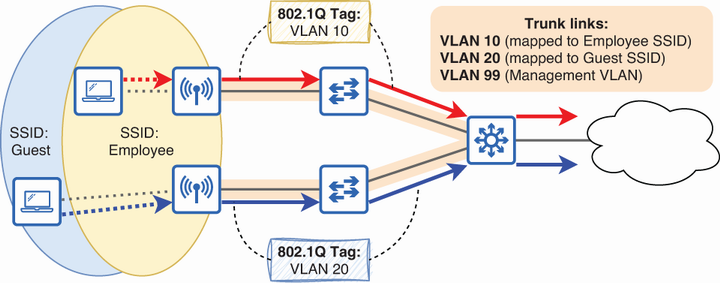
Use the topology figure to inspect how autonomous APs connect through trunk links and translate multiple SSIDs into wired VLANs. section 19.2.1
