An availability zone is a distinct physical and logical location inside some Azure regions. It contains one or more datacenters with independent power, cooling, and networking, helping services withstand hardware failures and outages. section 1.3.2 section 3.2.1
When creating a virtual machine in a supported region, choose a zone for its physical placement. Replicating applications and data across zones removes a single point of failure, although the zone’s exact physical location remains hidden. section 3.2.1
Keep these practical distinctions in mind:
- Availability zones are separate physical locations within a region, not separate Azure regions. section 3.2.1
- Each zone has independent power, cooling, and networking, reducing the chance that one infrastructure failure takes down every instance. section 3.2.1
- Availability sets use fault domains and update domains to distribute VMs across shared hardware and stagger maintenance; they are an alternative redundancy choice. section 3.2.1
- Not every region offers availability zones, so location selection affects the redundancy options available for a VM. section 3.2.1
A more resilient VM deployment
Suppose an application runs on several VMs in Australia East. Placing those VMs across the region’s availability zones separates them across independent power, cooling, and network infrastructure, making a single outage less likely to stop the application. section 3.2.1
Figure 3.13 Azure availability zones with separate cooling, power, and network
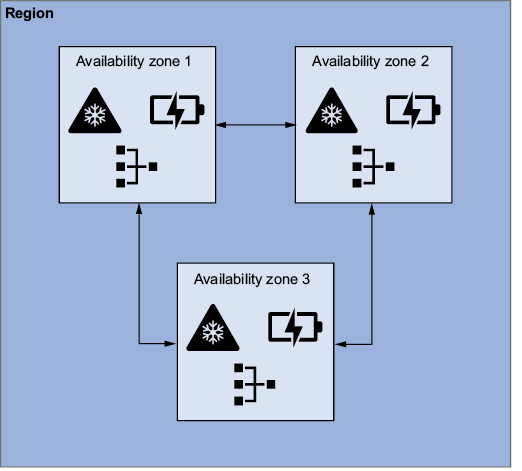
Use the diagram to see how separate cooling, power, and network infrastructure isolate Azure availability zones. section 3.2.1



