liveBook · Manning

Availability zone

As explained in ScyllaDB in Action

An availability zone is an isolated infrastructure failure domain within a cloud region that contains computing resources.

An availability zone is an isolated infrastructure failure domain within a cloud region that contains computing resources. Distributing ScyllaDB nodes across zones reduces the risk that one cloud-provider disruption takes the entire cluster offline. section 9.2.1

Why distribute nodes across zones?

A production cluster placed in one zone may lose availability if that zone fails. Placing nodes across multiple zones can preserve uptime and quorum consistency when one zone becomes unavailable, provided enough nodes remain. section 9.2.1

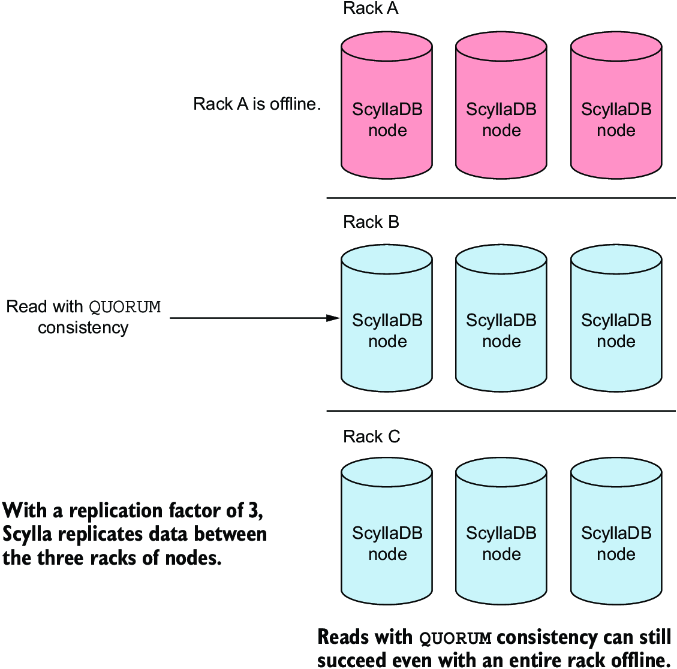
Figure 9.4 By running your Scylla cluster across multiple racks, you can tolerate the loss of an entire rack and still preserve quorum consistency.
figure

Use the topology figure to see how distributing nodes across separate failure domains preserves quorum after a domain fails. section 9.2.1


How ScyllaDB in Action covers it

How deep it goes
Explains zone placement through failure scenarios and resiliency guidance, but stops short of detailed cloud-provider configuration.
Examples
Uses a single-rack outage analogy and contrasts single-zone placement with nodes distributed across multiple zones.
What it assumes
Assumes familiarity with nodes, clusters, uptime, and quorum-based consistency.
What you can do after
Operate/configure production clusters by placing nodes across zones to tolerate infrastructure failures while maintaining quorum.
How it connects
Connects availability zones with ScyllaDB nodes, racks, quorum consistency, fault tolerance, and cloud-provider failures.

Also explained in

Compare how 4 books explain availability zone →

Related concepts

This explainer was generated by Manning's knowledge graph from the text of ScyllaDB in Action. The section links point to the parts of the book it draws on.

