liveBook · Manning

AWS Identity and Access Management

As explained in Amazon Web Services in Action, Third Edition: An in-depth guide to AWS

AWS Identity and Access Management is a service for controlling authentication and authorization to AWS resources.

AWS Identity and Access Management (IAM) controls authentication and authorization for the AWS API: it verifies who makes a request and whether that identity may perform the requested action. section 5.3.2

IAM organizes AWS access through four core components:

  • IAM users authenticate people or workloads running outside AWS. section 5.3.2
  • IAM groups collect users with shared permissions. section 5.3.2
  • IAM roles authenticate AWS resources such as EC2 instances and can be associated with ECS containers or Lambda functions. section 5.3.2
  • Identity policies define permitted actions for users, groups, or roles; identities have no permissions by default. section 5.3.2
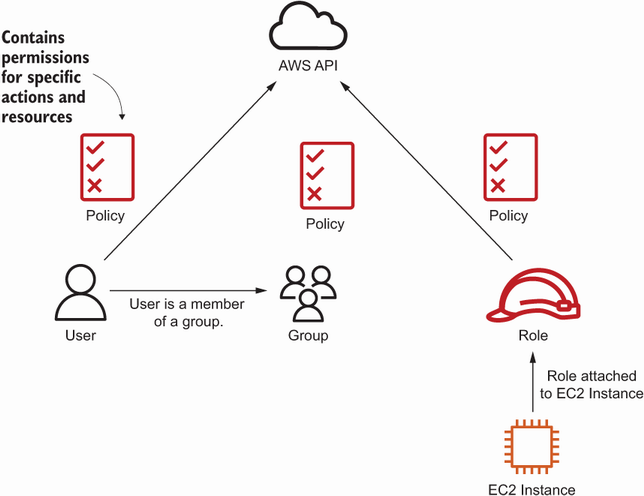
Figure 5.6 IAM concepts

Use the IAM concepts figure to compare users, groups, roles, and identity policies in one view. section 5.3.2

Grant only the permissions an identity needs. IAM governs AWS service configuration and management, but it does not replace service-level or network controls: RDS database access belongs to the database engine, while cache-node access uses security groups and optional Redis authentication. section 10.4.1 section 11.3.1

Restricting RDS administration

An identity policy can allow RDS management actions while explicitly denying rds:Delete* and rds:Remove*. The explicit Deny overrides an Allow, reducing the risk of destructive human errors. section 10.4.1


How Amazon Web Services in Action, Third Edition: An in-depth guide to AWS covers it

How deep it goes
Defines users, groups, roles, and policies, then applies least privilege and explicit denial to RDS and cache administration.
Examples
Uses EC2 roles, RDS management policies, destructive-action denial, and layered ElastiCache access controls as concrete examples.
What it assumes
Assumes only AWS resources and API requests, while defining authentication, authorization, users, groups, roles, and policies explicitly.
What you can do after
Operate/configure AWS access by assigning identities and policies, applying least privilege, and separating service, database, and network permissions.
How it connects
Connects IAM with the AWS API, identity policies, EC2, Lambda, RDS, ElastiCache, security groups, and database engines.

Also explained in

Compare how 2 books explain AWS Identity and Access Management →

Related concepts

This explainer was generated by Manning's knowledge graph from the text of Amazon Web Services in Action, Third Edition: An in-depth guide to AWS. The section links point to the parts of the book it draws on.