Azure Quantum Resource Estimator (AQRE) estimates the resources required to execute a quantum program on a specified fault-tolerant quantum-computing architecture. It supports programs written in both Qiskit and Q#; estimates depend on program behavior rather than input language. section 9.0 section 9.4
AQRE’s estimation workflow accounts for:
- Reducing a quantum program to logical resource estimates. section 9.4
- Selecting architectural parameters that execute the program within a given error budget. section 9.4
- Estimating effects from physical qubits, gates, magic gates, error correction, magic-state distillation, gate and measurement time, and qubit connectivity. section 9.8
Estimating an N queens program
A Q# entry point can invoke the N queens Grover-search implementation with four rows and nine iterations. AQRE then produces resource estimates for that program, which can be compared with classical solutions and other quantum implementations. section 9.4 section 9.0
Figure 9.7 The high-level inputs and processing logic of Azure Quantum Resource Estimator. The first step reduces the quantum program to a set of logical resource estimates. Then, AQRE looks for the parameters of the different architectural components of the quantum computer that allow to execute the program within the given error budget.
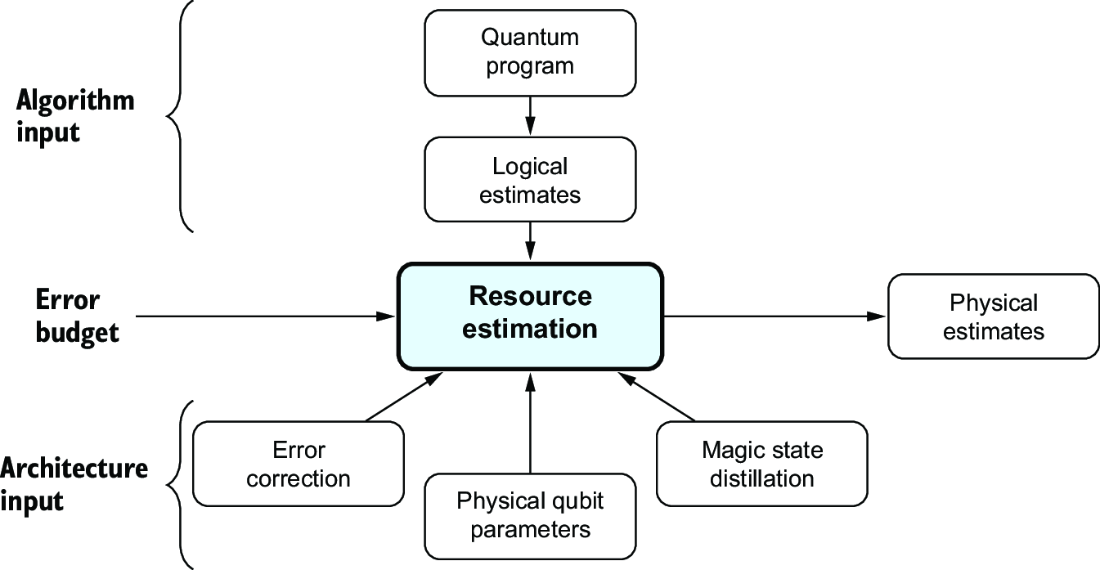
The workflow diagram shows how AQRE converts a program into logical estimates and searches for fault-tolerant architectural parameters within an error budget. section 9.4
