Resource estimation predicts whether a quantum program can run within a target machine’s limits and what it will cost in time and hardware. It turns a program into estimates such as logical and physical qubits, run time, and architectural requirements, rather than relying only on asymptotic complexity. For near-term devices, it helps determine whether a circuit uses few enough qubits and gates to finish before noise obscures its results; for fault-tolerant machines, it accounts for the overhead needed to execute reliably. section 1.3.4 section 9.0 section 9.8
Use estimates after implementing and testing a quantum program, before treating hardware execution as proof of usefulness. Compare alternative implementations of the same algorithm, identify resource-heavy choices early, and communicate requirements to hardware designers. A useful performance comparison includes accuracy, time, and cost, and uses the best known classical algorithm as the baseline rather than assuming a quantum speedup from asymptotic analysis alone. section 1.3.4 section 9.0 section 9.8
Realistic fault-tolerant estimates must reflect more than the program’s visible qubit count:
- Error correction maps logical qubits and gates used by the program onto multiple noisy physical qubits and operations. section 9.8
- Magic-state production can be a major resource cost when the program needs gates not directly supported by the machine. section 9.3 section 9.8
- Gate and measurement durations, limited qubit connectivity, and the target architecture affect total run time and qubit requirements. section 9.5 section 9.8
Specialized tools automate these calculations from a quantum program plus numeric and architectural assumptions. Azure Quantum Resource Estimator first reduces the program to logical resource estimates, then selects parameters for architectural components that can execute it within a supplied error budget. Its estimates depend on what the program does, not on whether the input is written in Qiskit or Q#; invocation differs by language. section 9.3 section 9.4
Figure 9.7 The high-level inputs and processing logic of Azure Quantum Resource Estimator. The first step reduces the quantum program to a set of logical resource estimates. Then, AQRE looks for the parameters of the different architectural components of the quantum computer that allow to execute the program within the given error budget.
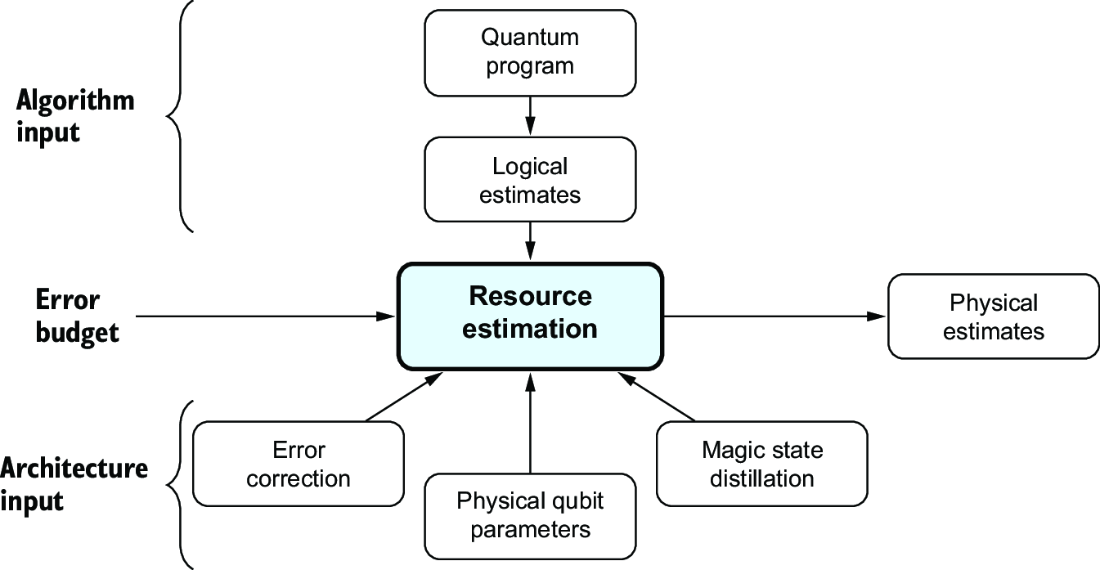
Inspect the two-stage estimation flow: derive logical resources from the program, then fit a fault-tolerant architecture to the error budget. section 9.4
Comparing N queens encodings
For the 10-queens puzzle, simulation is no longer practical, so resource estimation supplies the performance evidence. With default parameters, a cell-per-bit encoding is estimated at 37 minutes and 670,000 physical qubits; an encoding that stores each queen’s column index is estimated at 3 minutes and 340,000 physical qubits. The comparison shows that a more efficient representation can improve both qubit demand and run time. Estimates also expose a hardware tradeoff: accepting a longer run can reduce the physical-qubit capacity required. section 9.5
