Grover's algorithm
Grover's algorithm is a quantum search algorithm that finds a marked item in an unstructured search space with a quadratic speedup over classical exhaustive search.
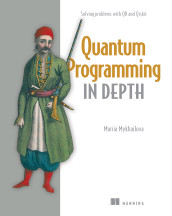
Quantum Programming in Depth
Grover's search algorithm is a quantum algorithm that finds a marked item in an unstructured search space with quadratic query-speedup over classical exhaustive search.
- How it is used
- Solves unstructured Boolean-function search through a generic quantum oracle while framing an end-to-end quantum program.
- How deep it goes
- Derives amplitude amplification as repeated reflections and implements parameterized circuits in Qiskit and Q#.
- Examples
- Implements a fixed-set marking oracle search and tests repeated measurements against marked states.
- What you can do after
- Build it from scratch in Qiskit or Q#, supply an oracle, choose iterations, test outputs, and validate candidates classically.
Read how Quantum Programming in Depth explains Grover's algorithm →
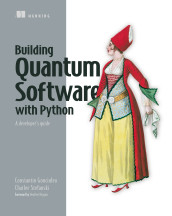
Building Quantum Software with Python
Grover’s algorithm is a quantum search algorithm that provides a quadratic speedup for finding a marked item in an unstructured search space.
- How it is used
- Deploys quantum measurement and amplitude amplification to search unstructured spaces for outcomes satisfying an oracle-defined criterion.
- How deep it goes
- Explains state preparation, phase marking, inversion, iteration, and circuit construction, including amplitude reports and concrete Python examples.
- Examples
- Demonstrates three-qubit search, marked outcomes, encoded functions, range predicates, and sign-based searches using Python circuit listings.
- What you can do after
- Apply it via quantum circuits by preparing a state, supplying an oracle, selecting iterations, inspecting amplitudes, and measuring candidate outcomes.
Read how Building Quantum Software with Python explains Grover's algorithm →

Real-World Cryptography
Grover's algorithm is a quantum search algorithm that finds a marked item in an unstructured search space using approximately the square root of the classical search effort.
- How it is used
- Explains how quantum search changes the security of symmetric cryptography and motivates larger security parameters.
- How deep it goes
- Defines the search advantage and cryptographic consequences but stops short of explaining the quantum circuit or proof.
- Examples
- Uses unordered-list search, 128-bit key search, AES-GCM choices, and SHA-3 parameter increases.
- What you can do after
- Evaluate quantum search risk and choose 256-bit symmetric parameters as a mitigation.
Read how Real-World Cryptography explains Grover's algorithm →
Related concepts
- unstructured searchaddresses · Unstructured search is the task of finding a marked or criterion-satisfying item in a search space without exploitable ordering or organization.
- quantum algorithmkind of · A quantum algorithm is a computational procedure designed to run on a quantum computer and exploit quantum-mechanical states or operations.
- Grover adaptive searchused by · Grover adaptive search is a hybrid quantum-classical search technique that varies the number of Grover-operator iterations according to a schedule when the number of desired outcomes is unknown.
- quadratic speedupproduces · A quadratic speedup is an asymptotic performance improvement in which the required computational resources scale as the square root of those required by a reference method.
- quantum computerused by · A quantum computer is a computing device that processes information using quantum-mechanical states and operations.
These guides are generated from the text of Manning books by Manning's knowledge graph and link to the sections they draw on. The full books are available on liveBook and at manning.com.