Grover's algorithm searches an unstructured space defined by a deterministic Boolean function f: {0,1}ⁿ → {0,1}. Given quantum-oracle access to f, it seeks any input x₀ with f(x₀)=1. Its query cost is O(√N) for N possible inputs, versus O(N) for classical brute-force search under the same oracle-access restriction; this is a quadratic, not exponential, speedup. section 1.3.1 section 7.2
The oracle is used generically: a phase oracle applies U_f|x⟩ = (-1)^f(x)|x⟩, changing the relative phase of solution states without exposing the function's implementation. A marking oracle can be converted into a phase oracle with phase kickback, letting the search routine accept problem-specific oracle code as an argument. section 7.2 section 7.4
Figure 7.7 The overall structure of Grover’s search algorithm. You start by preparing the system in the mean state, the average of all states in the search space. Then you apply several iterations, each com-posed of applying the phase oracle followed by a reflection about the mean. Finally, you measure the system and check whether the result is an answer to the problem.
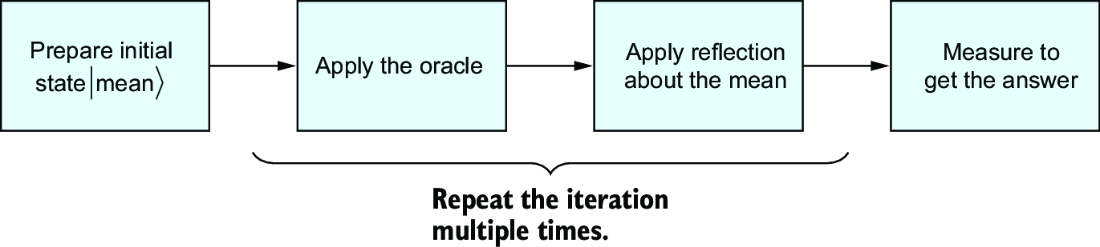
The algorithm prepares the mean state, repeats a phase-oracle-and-reflection iteration, measures, and then checks the candidate answer. section 7.2.2
Each Grover iteration first marks solutions through the phase oracle and then reflects amplitudes about their mean. These two reflections act as a rotation toward the solutions state: solution amplitudes and measurement success probability rise until the state is near that direction. Applying too many iterations rotates past it and lowers success probability, so iteration count matters. section 7.2.2
A practical implementation separates reusable search logic from the problem oracle:
- Provide the input-register size, a marking oracle, a mean-state preparation operation, and an iteration count. section 7.2.3 section 7.2.4
- Convert the marking oracle to a phase oracle, prepare the mean state, and repeat the Grover iteration before measurement. section 7.2.3 section 7.2.4
- Run the program repeatedly and verify that measured candidates belong to the marked set; also evaluate f(x₀) classically to validate a returned answer. section 7.2.3 section 7.4
Generic circuit interface
A Qiskit implementation constructs an iteration from a phase oracle and reflection about the mean, raises that iteration to n_iterations, then measures the input qubits. The corresponding Q# operation receives the marking oracle and mean-state operation as operation arguments, applies the same loop, and returns measured Boolean values. Both designs make the search routine independent of the particular marked inputs. section 7.2.3 section 7.2.4
Grover's algorithm is probabilistic: even a well-chosen iteration count can leave a nonzero chance of an incorrect measurement. It is most meaningful when the search is genuinely unstructured and oracle-query cost is the relevant comparison; favorable asymptotic complexity alone does not settle practical usefulness. section 7.2.2 section 1.3.1


