A backend is the service-side part of a Domain IDE. It exposes an API for the frontend and stores business knowledge in a repository. Together with the frontend, it supports domain experts editing DSL content while a build system uses that content to generate and build the Runtime. section 1.2.2 section 1.5
A simple persistence backend can:
- Store one serialized AST as a JSON file on disk. section 7.0
- Serve the stored content through a REST API: the frontend retrieves it with GET and replaces it with PUT. section 7.0
- Serialize AST objects to JSON for storage and HTTP transport, then deserialize JSON to reconstruct the AST. section 7.0
- Preserve reference relations during serialization and deserialization so the reconstructed AST retains its intended structure. section 7.0
Persisting an edited DSL model
A frontend sends an edited AST to the backend with PUT. The backend replaces its JSON file; a later GET retrieves that JSON, and deserialization reconstructs the AST for editing. section 7.0
Figure 1.14 The architecture of the Domain IDE
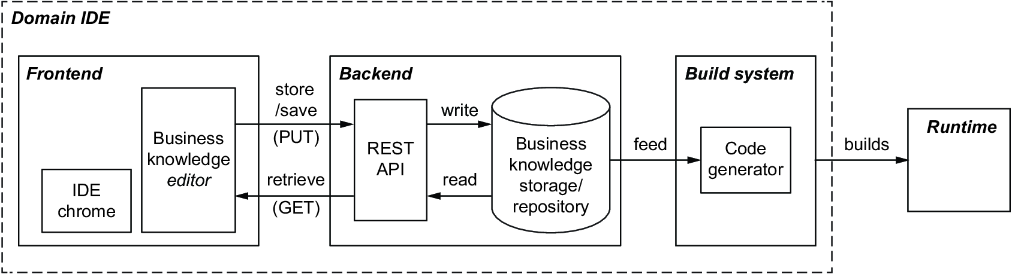
Use the architecture diagram to trace the frontend, backend API, repository, build system, generator, and Runtime as one system. section 1.2.2



