A backend service is a server-side application component that applies business rules, accesses databases, performs computation-heavy work, integrates with other services, and exposes functionality through APIs. Application frontends use these services to complete tasks for users. section 1.1
Backend services are shaped by several operational and architectural requirements:
- Well-designed APIs reduce unnecessary roundtrips between clients and services. section 1.2
- High throughput, short response times, predictable latency, and availability support varying application loads. section 1.2
- Services may run as individual processes on physical or virtual machines, or as containerized microservices managed by orchestration environments. section 1.1
- Backends interact with infrastructure such as databases, key/value stores, caches, messaging systems, load balancers, proxies, and service discovery platforms. section 1.1
Social media application stack
A social media application can place frontend clients above backend services, with distributed infrastructure supporting communication, persistence, operations, security, and monitoring. section 1.1
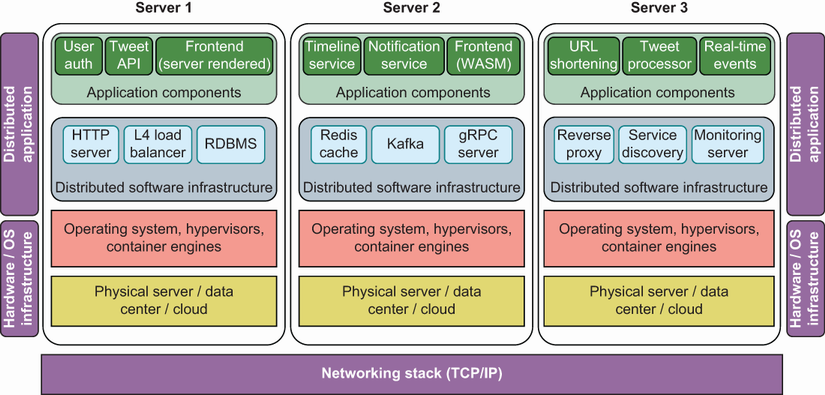
Use the distributed-stack figure to trace how frontends, backend services, and supporting infrastructure cooperate in a social media application. section 1.1



