A backend is the low-level engine beneath a high-level API such as Keras. It executes tensor operations, gradients, and other numerical work needed to build, train, and run models. section 3.2 section 3.6.1
Keras backends provide practical flexibility:
- TensorFlow is the default backend in a fresh keras3 environment. section 3.6.1
- JAX, TensorFlow, and PyTorch can be selected interchangeably after Keras code is written. section 3.6.1
- Backends can target CPU, GPU, or TPU hardware and support deployment across platforms. section 3.6.1
- NumPy supports prediction workflows but cannot train models because it does not provide gradients. section 3.2
Selecting a backend in R
Call use_backend() before working with Keras. For example, library(keras3); use_backend("jax") selects JAX and declares its Python dependencies automatically. The Keras R package also accepts KERAS_BACKEND values such as "jax-gpu"; use "torch" for the PyTorch backend. section 3.6.1
Figure 3.4 Keras and its backends. A backend is a low-level tensor computing platform; Keras is a high-level deep learning API.
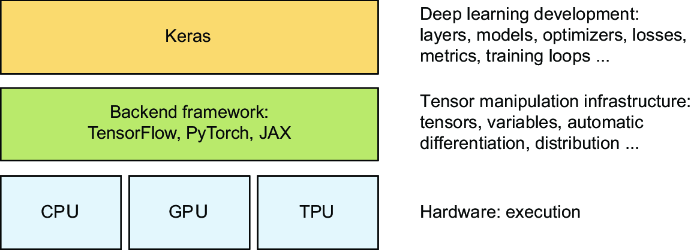
Use the architecture diagram to distinguish Keras as the high-level API from backends as low-level tensor-computing platforms. section 3.2




