A base learner is an individual predictive model used as a component of an ensemble. Ensemble methods combine several learners to reduce variance, reduce bias, or improve predictions; accuracy and diversity determine whether the ensemble outperforms its members. section 7.5
Base learners participate in ensembles through distinct training and aggregation patterns:
- Bagging trains learners independently on bootstrap samples, then aggregates classification by voting or regression by averaging. section 7.5.1
- Boosting trains weak learners sequentially on weighted data, emphasizing examples misclassified in earlier rounds; weighted voting or summation produces the prediction. section 7.5.2
- Stacking trains base-level models on the complete training set and supplies their outputs as features to a meta-classifier or meta-regressor. section 7.5.3
- Learners may be homogeneous, such as multiple models of one type, or heterogeneous, such as KNN, random forest, and naive Bayes. section 7.5 section 7.5.3
Decision stumps in AdaBoost
An AdaBoost ensemble uses decision trees of depth 1 as base learners. Each stump partitions the feature space with a threshold; later rounds increase weights for misclassified observations, while more accurate learners receive greater ensemble weights. section 7.5.2
Figure 7.15 AdaBoost algorithm pseudo-code
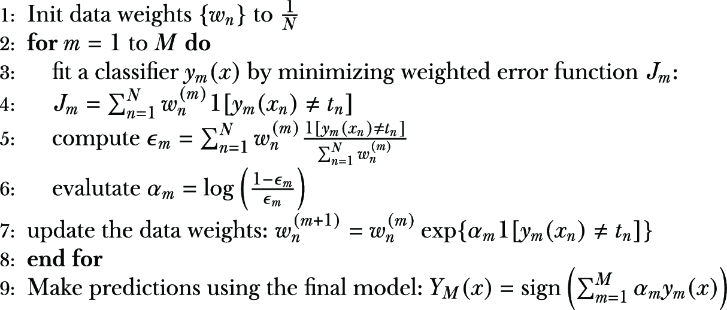
Follow the AdaBoost pseudo-code to inspect learner weighting, data-example weights, and sequential ensemble construction. section 7.5.2

