Batch normalization stabilizes layer inputs during training by normalizing activations with the mean and variance computed from each minibatch. A minibatch is the subset of training data processed in one forward and backward pass. More consistent activation distributions can reduce internal covariate shift, support higher learning rates, reduce sensitivity to weight initialization, and speed convergence. section 4.4.1
In pre-activation ResNets, batch normalization and ReLU are placed before the convolutional layers, leaving the skip connection unchanged. This design had slightly higher training error but lower test error than the original post-activation design; the difference was attributed to a regularizing effect from batch normalization at each convolution’s input. section 3.4.1
Sequence-wise normalization in DS2
Deep Speech 2 adapted batch normalization along the temporal dimension. This sequence-wise form helped stabilize recurrent-network training and improve generalization; alongside SortaGrad, it supported training deeper networks with greater stability. section 4.4.1 section 4.4.2
Figure 3.5 Left: the original residual unit shows two “weight” layers (that is, convolutional layers), with batch normalization (BN) and ReLU activations between them, followed by an additional step that merges with the identity connection. Right: the revised residual unit reorganizes the operations by placing BN and ReLU before the weight layers, simplifying the pathway. The gray arrows highlight the direct paths (that is, skip connections) that support the smooth forward and backward flow of information through the residual connections. Used with permission granted by the lead author (Kaiming He).
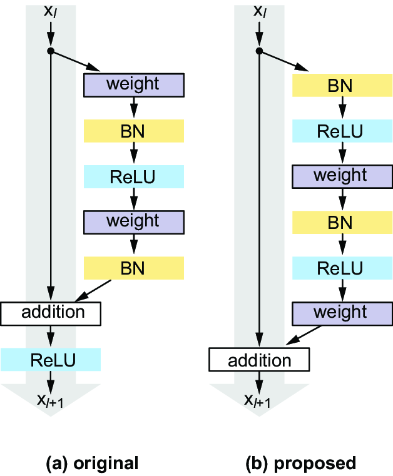
Compare the original residual unit with the pre-activation layout, including where batch normalization sits relative to the convolutional layers and skip connection. section 3.4.1








