Bias mitigation reduces harmful or unfair behavior by changing conditions under which an AI system learns, reasons, retrieves information, or produces visible outputs. Interventions can act at different stages of the model lifecycle. section 7.4.4
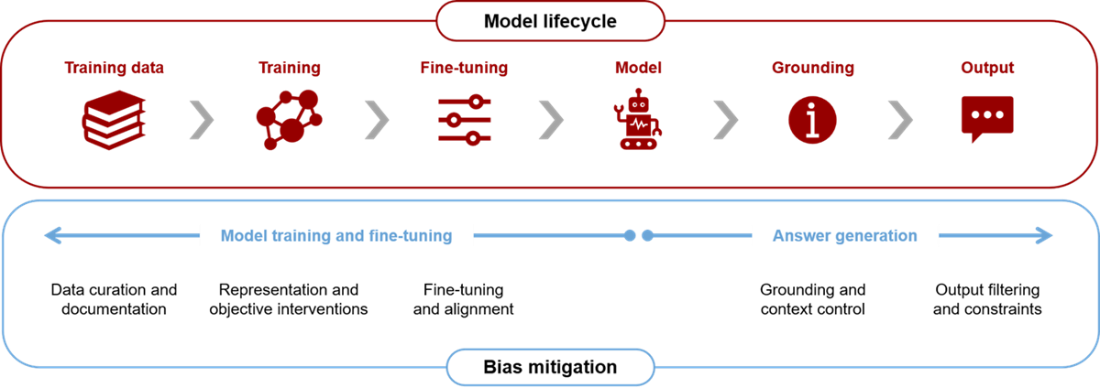
Interventions can target different stages:
- Before training, filter, rebalance, deduplicate, or expand data, and document its sources, exclusions, and known limitations. section 7.4.4
- During model development, reduce unwanted associations in representations or use fairness constraints, reweighting, and adversarial debiasing. section 7.4.4
- Fine-tune or align behavior, ground generation in curated information, or constrain outputs before they reach users. section 7.4.4
These layers can reduce harmful patterns, but they are not a single cure. Data cannot be made a neutral mirror of reality, and learned behavioral tendencies do not guarantee fair outcomes; bias can persist or reappear. section 7.4.4 section 7.5
Figure 7.8 Bias mitigation across the model lifecycle. Bias can be addressed at several points: curating and documenting training data before learning begins, changing training objectives or internal representations during model development, using fine-tuning and alignment to reinforce desired behavior, grounding generation in curated context, and filtering or constraining outputs before they reach the user. These layers can reduce harmful behavior, but none removes the need to keep inspecting how bias enters and reappears in the system.
Compare intervention points across the lifecycle, from data preparation through output constraints. section 7.4.4


