The bias–variance tradeoff describes how model complexity changes generalization. More capacity can capture useful signals and reduce bias, but it can also increase sensitivity to training-data fluctuations and overfitting. section 9.1.1
Use the following distinctions when reading model performance:
- Underfitting reflects high bias: a model is too simple, misses important feature–target relationships, and performs poorly on both training and unseen data. section 9.1.1
- Overfitting reflects high variance: a model performs well on training data but learns insignificant patterns that fail to generalize. section 9.1.1
- Model complexity can involve tree depth, feature count, or neural-network layer count; increasing it usually lowers training error while increasing variance. section 9.1
- Learning-curve analysis helps assess whether changing complexity or adding training samples could improve performance. section 9.1
The U-shaped validation error
As model parameters increase, training error tends to keep falling while bias decreases. Variance rises, so validation error can form a U-shape; the practical goal is the balance near its minimum. section 9.1
Figure 9.2 With an increasing number of model parameters, training error tends to become lower and lower while minimizing bias. At the same time, the model variance increases, providing us with a U-shaped validation error.
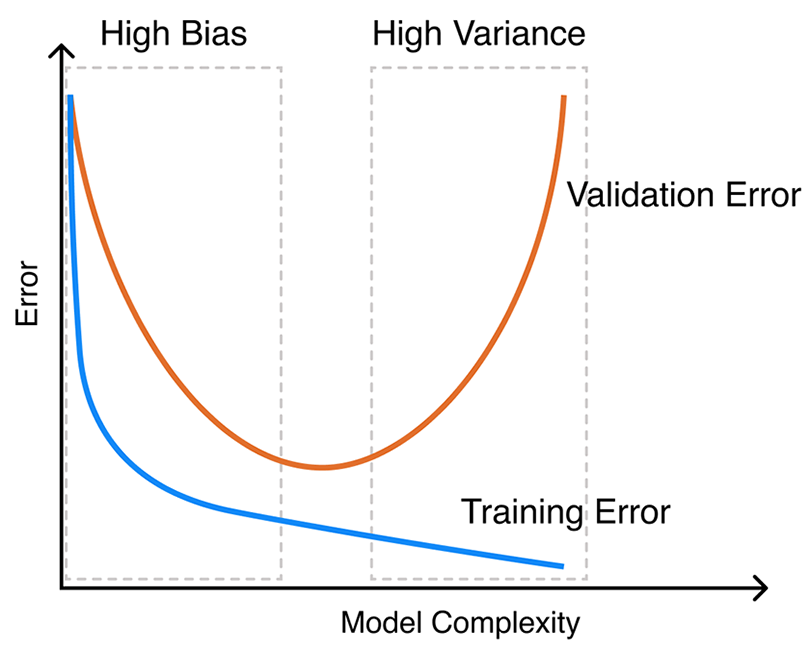
Shows the opposing movement of training error, bias, variance, and validation error as model parameters increase. section 9.1


