The bias–variance tradeoff describes how mean squared error balances squared bias against variance. A biased estimator can achieve lower MSE when the variance reduction outweighs the added bias. section 7.8 section 7.3.1
Variance reduction connects the tradeoff to estimation limits and active data selection:
- The Cramér–Rao lower bound limits the variance of unbiased estimators when p(x|θ) satisfies the regularity condition. section 7.3.1
- The minimum-variance unbiased estimator reaches the inverse Fisher information matrix; multivariate models use a K × K information matrix. section 7.3.1
- An active learner can select data that maximizes Fisher information, using A-, D-, or E-optimality to reduce different summaries of inverse information. section 7.3.1
- Variance-reduction methods can be slower than uncertainty sampling because they invert a K × K matrix for every unlabeled instance, with complexity O(UK³). section 7.3.1
Active learning for logistic regression
A two-feature, two-class logistic-regression experiment compares random sampling with active-learning query strategies. The comparison includes uncertainty sampling and average KL divergence, with active learning shown to outperform random sampling in the associated evaluation. section 7.3.1
Figure 7.11 Uncertainty sampling techniques comparison. The left figure shows that active learning is better than random sampling. The right figure shows that average KL divergence is better than random sampling.
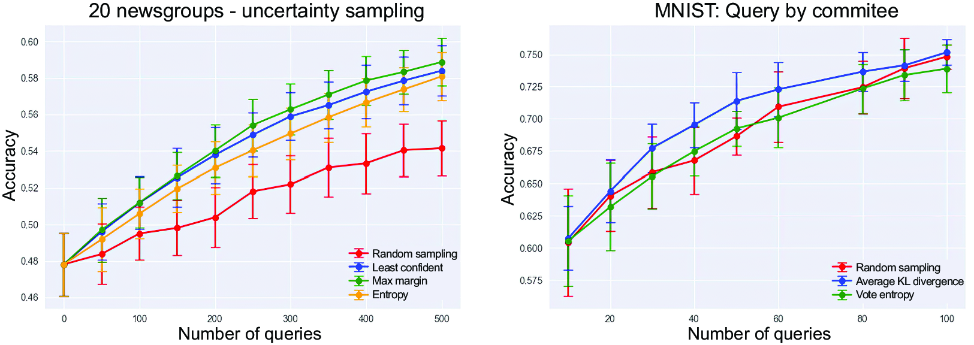
Compare uncertainty-sampling techniques and average KL divergence against random sampling in the plotted active-learning evaluation. section 7.3.1


