The bias–variance trade-off balances systematic error from an overly simple model against variability from an overly flexible one. In drug discovery, it helps assess models predicting compound solubility, a property tied to absorption, bioavailability, and therapeutic performance. section 4.0
Validation and learning curves make the trade-off practical. Validation curves vary model complexity or preprocessing settings, while learning curves vary the number of data points; comparing training, validation, and generalization errors helps reveal overfitting and guide mitigation. section 4.0 section 4.4.3
Figure 4.21 How different errors (train, validation, generalization) and bias and variance change as a function of the number of data points (left, learning curve) or the model complexity (right, validation curve).
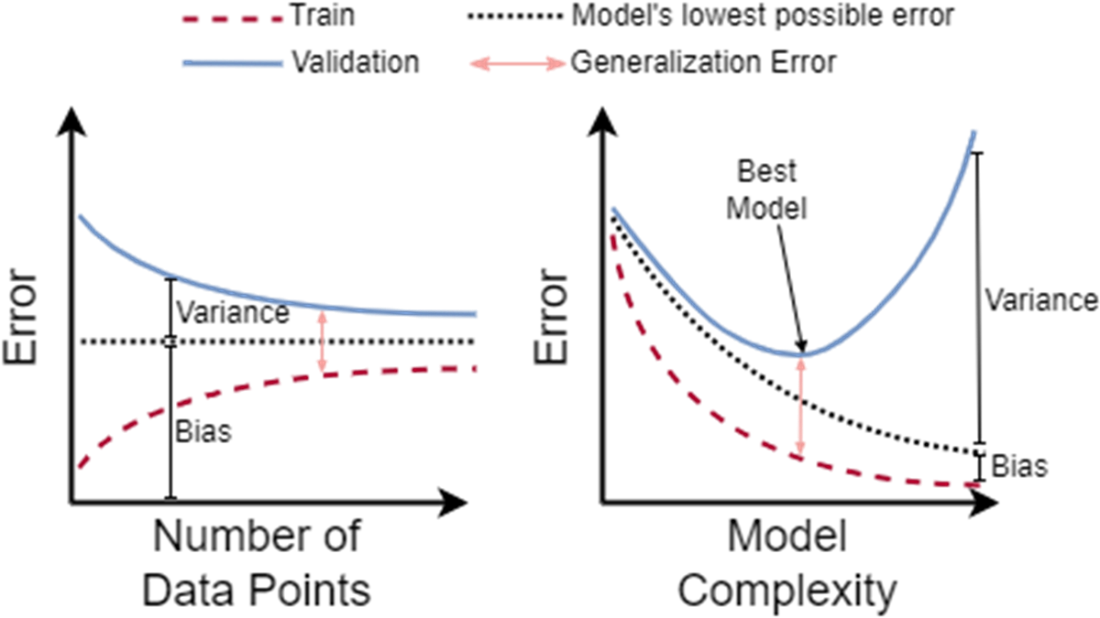
Use the figure to inspect how training, validation, and generalization errors, along with bias and variance, change with data volume and model complexity. section 4.4.3
Solubility-model validation
A solubility workflow compares linear regression with more complex models such as RANSAC and support vector regression, then examines validation behavior and applicability domain. section 4.0 section 4.4.3




