Binary representation uses sequences of 0s and 1s to encode computer data and computational information. A bit is one binary digit; eight bits make one byte. Computers compute and communicate in binary, while people commonly view the results in more readable forms. section 3.2
In networking, devices send long sequences of bits across a physical medium. Over copper, changing the voltage of an electrical signal can represent 0 and 1; the exact signaling method depends on the medium. section 3.2 section 3.5
Use these fundamentals when reading binary values:
- Treat binary as base 2: each position doubles in value from right to left. section 7.2.2
- Call the rightmost digit the least-significant bit and the leftmost digit the most-significant bit. section 7.2.2
- Convert binary to decimal by adding the positional values of every bit set to 1. section 7.2.2
- Read IPv4 addresses as four groups of 8 bits, so conversion practice focuses on one byte at a time. section 7.2.2 section 7.0
Converting an 8-bit value
For 00101111, add the values of the 1 bits: 32 + 8 + 4 + 2 + 1 = 47. Repeated practice with random 8-bit values builds fluency for IPv4 work. section 7.2.2
Figure 3.1 A router sends 1 byte of data to a switch. Changes in the voltage of the electric signal indicate values of 0 or 1.
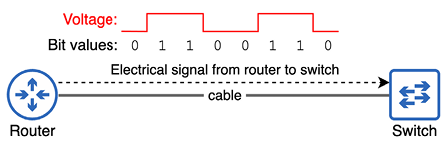
Trace how a router sends one byte to a switch through voltage changes that represent binary values. section 3.2





