A binary string is a finite sequence of 0s and 1s. In quantum computing, measurement returns one binary string, with one digit for each measured qubit; the string is commonly interpreted as a decimal integer. section 1.3.2 section 2.2.1
Use binary strings to represent quantum computation outcomes:
- An n-qubit system has n-digit binary-string outcomes and 2^n possible strings. section 2.2.1
- Each execution produces one outcome sampled according to the measurement probabilities defined by the quantum state. section 1.3.2 section 1.4.3
- Groups of qubits can encode variables in separate quantum registers, such as item selection, value, and weight. section 2.2.1
Three-qubit outcomes
A three-qubit computation can return 000, 001, 010, 011, 100, 101, 110, or 111. Interpreting the result as an integer maps 100 to 4; repeated runs reveal the distribution of possible outcomes. section 1.4.3 section 1.3.2
Figure 1.9 The steps of a quantum computation using quantum bits (qubits). The example in the diagram uses three qubits, so there are eight possible outcomes, each with a certain measurement probability represented by the filled part of the sectors. When a measurement is performed, we get one result according to the probabilities. The result is interpreted as a binary string.
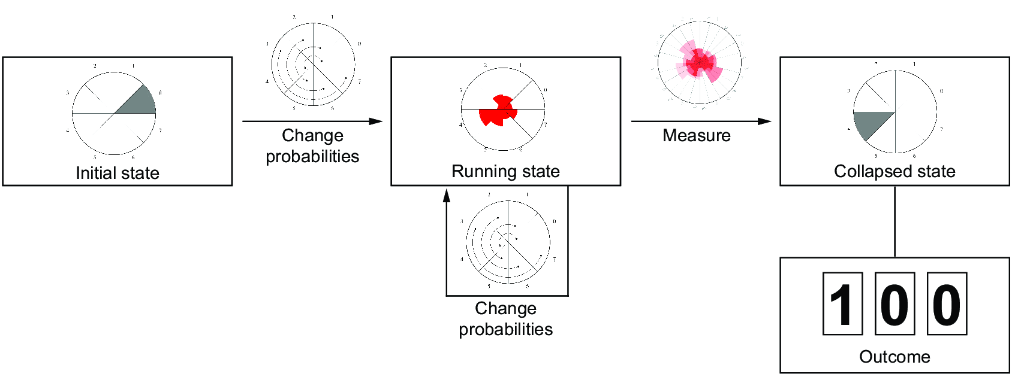
Visualizes a three-qubit computation as several possible binary-string outcomes, each weighted by its measurement probability, followed by selection of one result. section 1.4.3




