Blazor Server is a stateful, server-rendered hosting model for building interactive applications. UI rendering and event handling remain on the server, while UI events and page updates travel between server and browser over WebSockets. This gives the application a client-side single-page feel without requiring a browser-based WebAssembly application. section 1.2 section 1.6
Use Blazor Server when these characteristics fit the application:
- Keep application state and rendering on the server while delivering interactive page updates to the browser. section 2.3
- Choose it as an alternative to Blazor WebAssembly when server-rendered development is more suitable than running the application in the browser. section 1.2
- Combine it with other ASP.NET Core paradigms when one application needs multiple application styles. section 1.2
Gradual migration from Web Forms
A large Web Forms application may be difficult to convert directly because conversion effectively involves rewriting the application and potentially changing design paradigms. Blazor Server offers a stateful, component-based model similar to Web Forms, allowing pages to migrate gradually to ASP.NET Core. section 2.4.3
Figure 2.5 ASP.NET Core can act as the server-side application for a variety of clients: it can serve HTML pages for traditional web applications, act as a REST API for client-side SPA applications, or act as an ad hoc RPC service for client applications.
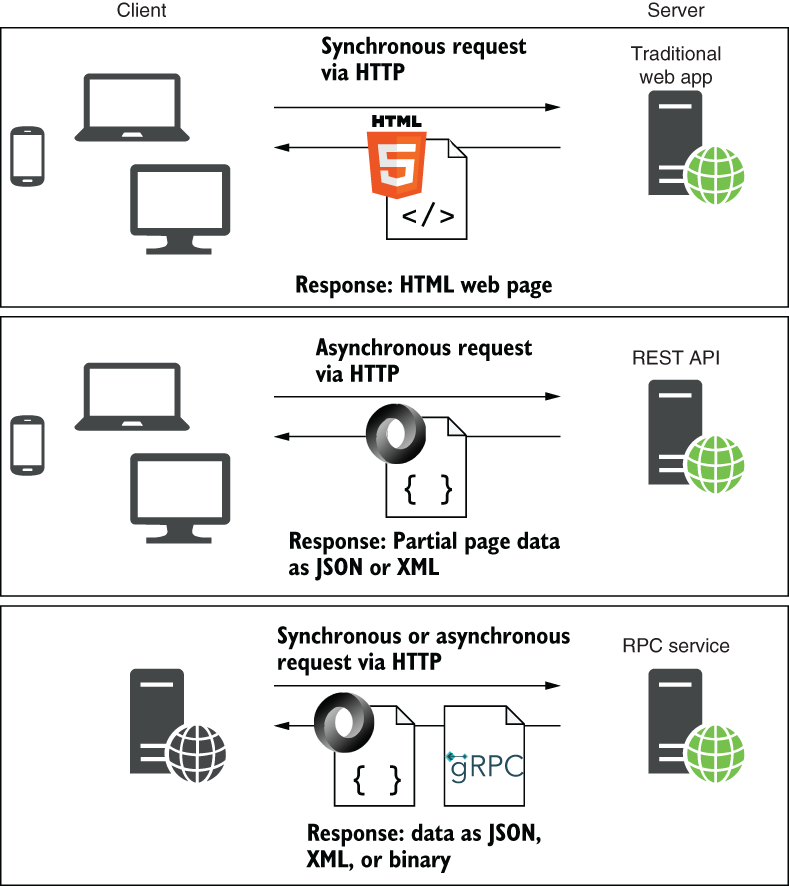
Compare Blazor Server with ASP.NET Core applications that serve HTML pages, expose REST APIs, or provide RPC services. section 2.3

