liveBook · Manning

Boundary representation

As explained in Robotics for Programmers

Boundary representation is a solid-modeling scheme that defines an object through its bounding faces, edges, vertices, and their connectivity.

Boundary representation (B-rep) defines a solid by explicitly describing the surfaces forming its boundary. It records both geometry and topology: how faces, edges, and vertices connect into a closed, watertight volume. section 6.1.5

A B-rep organizes a solid through connected elements:

  • Faces describe the boundary surfaces. section 6.1.5
  • Edges bound faces and connect adjacent surface regions. section 6.1.5
  • Vertices terminate edges and complete the topology. section 6.1.5
  • Meshes and curve models are specific B-rep instances; meshes use polygon networks, while curve models use smooth curved patches. section 6.1.5

This explicit connectivity makes B-rep precise and unambiguous for detailed engineering design. CAD and CAE systems commonly exchange B-rep data through STEP and IGES formats. section 6.1.5

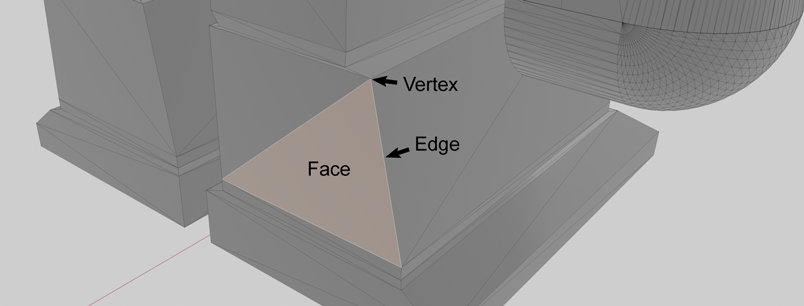
Figure 6.14 Meshes represent complex 3D surfaces as connected networks of polygons, typically triangles defined by vertices, edges, and faces.
CH06 Fxx bihlmaier meshes

A mesh illustrates the polygonal surface networks that can serve as B-rep geometry. section 6.1.5


How Robotics for Programmers covers it

How deep it goes
Explains faces, edges, vertices, geometry, topology, and watertight closure, while stopping short of construction algorithms.
Examples
Uses polygon meshes, smooth NURBS patches, and STEP or IGES exchange formats as concrete representations and artifacts.
What you can do after
Evaluate shape representations by their surfaces, connectivity, closure, and exchange formats.
How it connects
Connects boundary representation with meshes, curve models, CAD, CAE, volumetric models, voxels, and point clouds.

Also explained in

Compare how 2 books explain boundary representation →

Related concepts

This explainer was generated by Manning's knowledge graph from the text of Robotics for Programmers. The section links point to the parts of the book it draws on.