Pausing a Node.js Readable stops data events, not chunk production: chunks accumulate in its internal buffer until flow resumes. section 10.3.1
A pipeline has separate buffers for the Readable, a Transform’s inbound and outbound data, and the Writable. Each has its own highWaterMark. Exceeding one prompts an advisory signal for upstream stages to slow down; ignoring it lets chunks accumulate. section 10.3.1
Writable backpressure
When writable.write() returns false, stop writing until the 'drain' event. Continuing to write can add data to the buffer despite the signal. section 10.3.1
Figure 10.5 Data flow through a Node.js pipeline with a single Transform. Data moves downwards through four internal buffers: the Readable's buffer, the Transform's inbound buffer, the Transform's outbound buffer, and the Writable's buffer. Each buffer has its own highWaterMark. Backpressure propagates upwards: when any buffer exceeds its mark, the upstream stage is signaled to slow down. Every signal is advisory, and every buffer is a point where chunks can accumulate and survive into old generation if the signal is ignored.
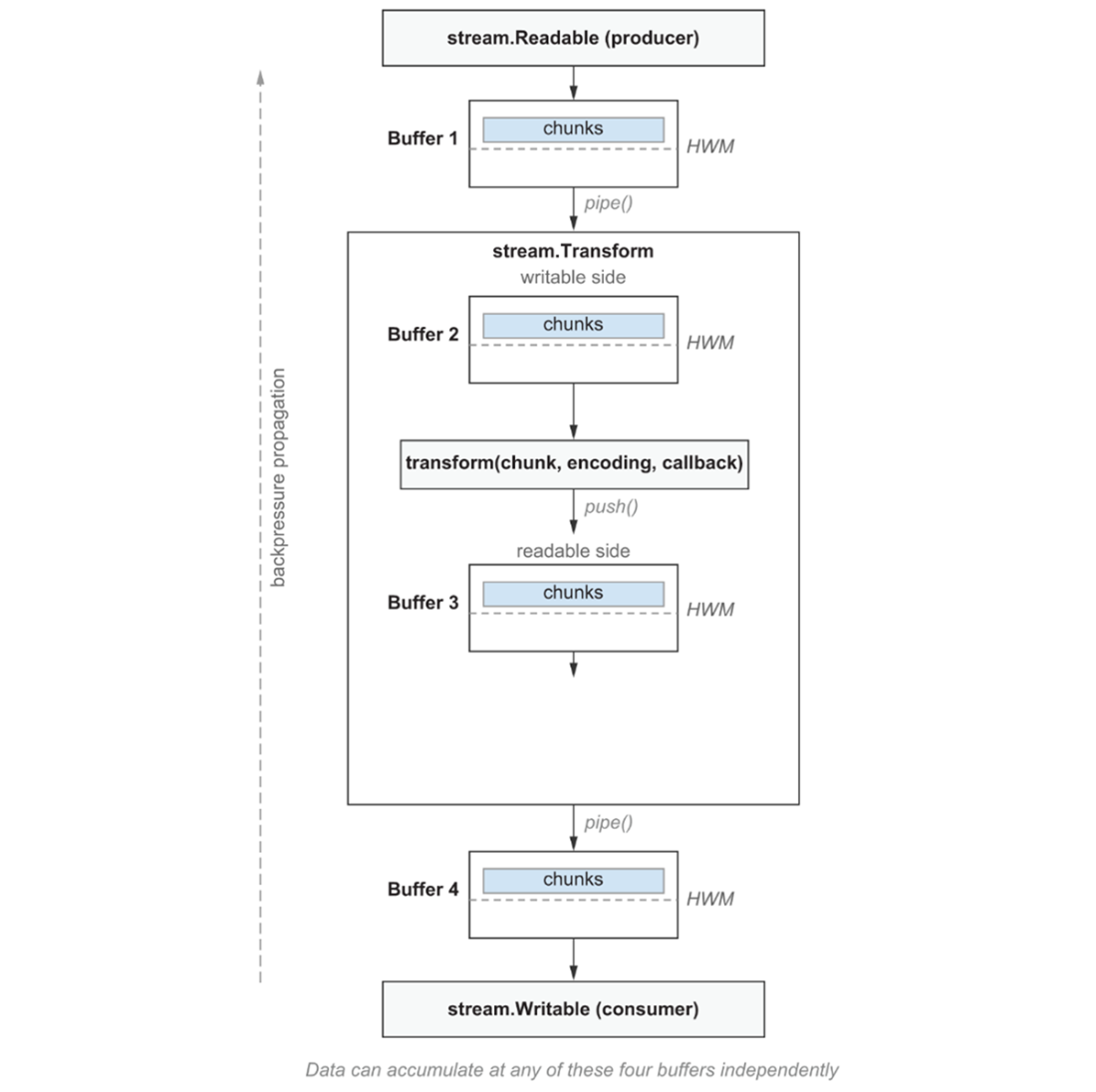
Trace how data passes through four distinct buffers and how backpressure signals move upstream. section 10.3.1
Web Streams call the underlying source’s pull() when the internal queue has room, tying production to the consumer’s pace. Enqueuing outside that pull cycle can bypass this protection. section 10.4.1 section 10.9







