Suppose you want to know whether increasing side-quest engagement would change in-game purchases. A correlation between engagement and purchases does not answer that intervention question. A causal assumption constrains how the variables are related so that data can support a causal inference, not just a prediction. section 1.1 section 10.2.2
The first practical step is to state what you believe causes what. A causal directed acyclic graph (DAG) makes those beliefs visible as edges between variables. It is an account of the data-generating process, not a diagram verified simply by fitting it to data. The graph says *what* causes an effect, but not *how* the effect is produced: different logic gates, for example, can share the same causal DAG. section 3.1.2 section 3.1.3
Choose assumptions at the level the question requires:
- Associational models make statistical assumptions about observed relationships. Those assumptions alone do not establish an intervention’s consequences. section 10.1.2
- A causal DAG makes interventional assumptions about what causes what. Its structure can supply the level of assumptions needed for an intervention query. section 10.1.2 section 10.2.2
- A structural causal model (SCM) can add assumptions about *how* causes act—for instance, a proportional increase in height for each unit increase in femur length. These mechanism assumptions can support further inferences, including counterfactual queries, but create more opportunities for modeling error. section 6.1 section 6.1.5
Which uncertain edge matters?
For an average treatment effect of side-quest engagement on in-game purchases, uncertainty about whether time spent playing causes skill level or the reverse need not matter to the chosen backdoor estimand. An omitted common cause of engagement and purchases does matter: it would violate the assumption that adjustment handles the relevant confounding. Judge an uncertain graph against the assumptions needed for the particular estimand, rather than requiring every edge to be settled. section 11.3.4
Figure 11.7 Direct influence of a latent variable on the treatment and outcome would violate the assumption underpinning the backdoor adjustment estimand. If you are not confident in an estimand’s assumptions, target another.
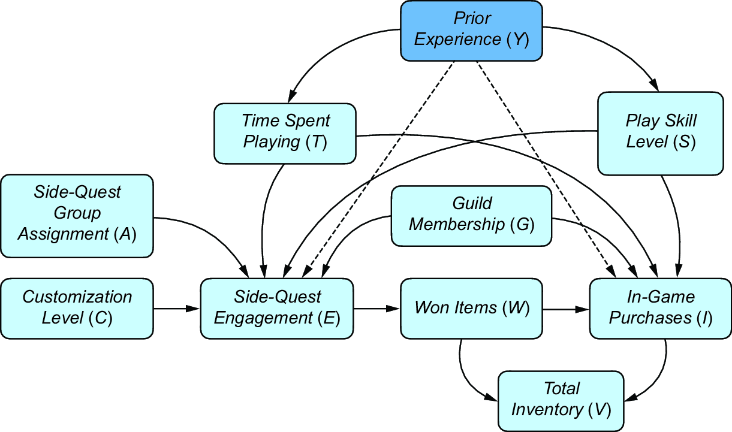
The diagram shows how a latent variable influencing both treatment and outcome threatens the backdoor adjustment assumption. section 11.3.4
A workable sequence is to pose the causal query, build a model, check whether the query is identifiable from that model and the available data, then estimate it. If identification fails, seek additional observed variables, reconsider the assumptions, or leave the question unanswered. After estimation, test sensitivity to assumption violations. Observational data cannot verify every causal assumption; a robustness check that adds an unobserved confounder can show how quickly the estimated effect changes. section 10.2.2 section 11.3.4 section 11.5.5
More detail is not automatically better. Two SCMs can agree on observational and interventional distributions yet produce different counterfactual inferences because they encode different mechanisms. Use additional assumptions when they help answer the target question, and account for the risk if they are wrong. section 10.6.1 section 6.1.5

