A causal question asks about an intervention, causal effect, counterfactual outcome, causal discovery, or decision defined by a causal model. Unlike correlation or prediction, it specifies what quantity the analysis must identify and estimate. section 1.5.3 section 12.2
Turn a practical question into an estimable causal query through five steps:
- Pose the question and express it mathematically, using probability, expectation, do-notation, or counterfactual notation. section 1.5.3 section 7.3.1
- Build a causal model whose assumptions match the query, including causally relevant variables whether or not the dataset measures them. section 3.3 section 10.2.2
- Check identification before estimation; if the query is not identified, collect additional variables, revise assumptions, or stop. section 10.2.1 section 10.2.2
- Estimate the identified quantity with statistical methods, then refute the result through sensitivity analysis against assumption violations. section 10.2.2
Conditioning versus intervention
“What are in-game purchases for players highly engaged in side-quests?” describes P(I|E=high), a subgroup distribution. “What would purchases be if engagement were set to high?” describes P(I|do(E=high)), an intervention query. section 7.3.1
Causal questions in AI
A vision model can ask how writer type changes digit-4 pixels, what a digit would look like under increased curviness, or which curviness produces an aesthetically ideal image. section 1.5.3
Figure 10.4 The causal inference workflow. The identification step is an essential step in the workflow.
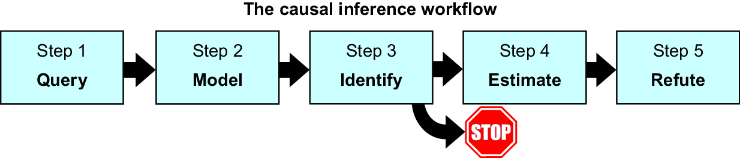
Use the workflow diagram to navigate from query formulation through modeling, identification, estimation, and refutation. section 10.2.2
